
Who are the characters in COADF?
We all know the ending before the first page is even turned: Santiago Nasar is going to be killed. However, the real mystery in Marquez’s surrealist fiction does not lie in who killed him, but lies in how an entire township permitted a murder to happen in broad daylight.
To truly understand the tragedy, we have to look past the blood on the doorstep and dive into the people who stood by. From the “dishonoured” Angela Vicario to the lethargic local authorities and the bystanders paralysed by social convention, every character in this chronicle holds a “shard” from the “broken mirror of memory.”
So, to make the story easier to understand and the characters easier to keep track of, we’ve created a ‘treebank’ of the main characters right here for your referral at any time.
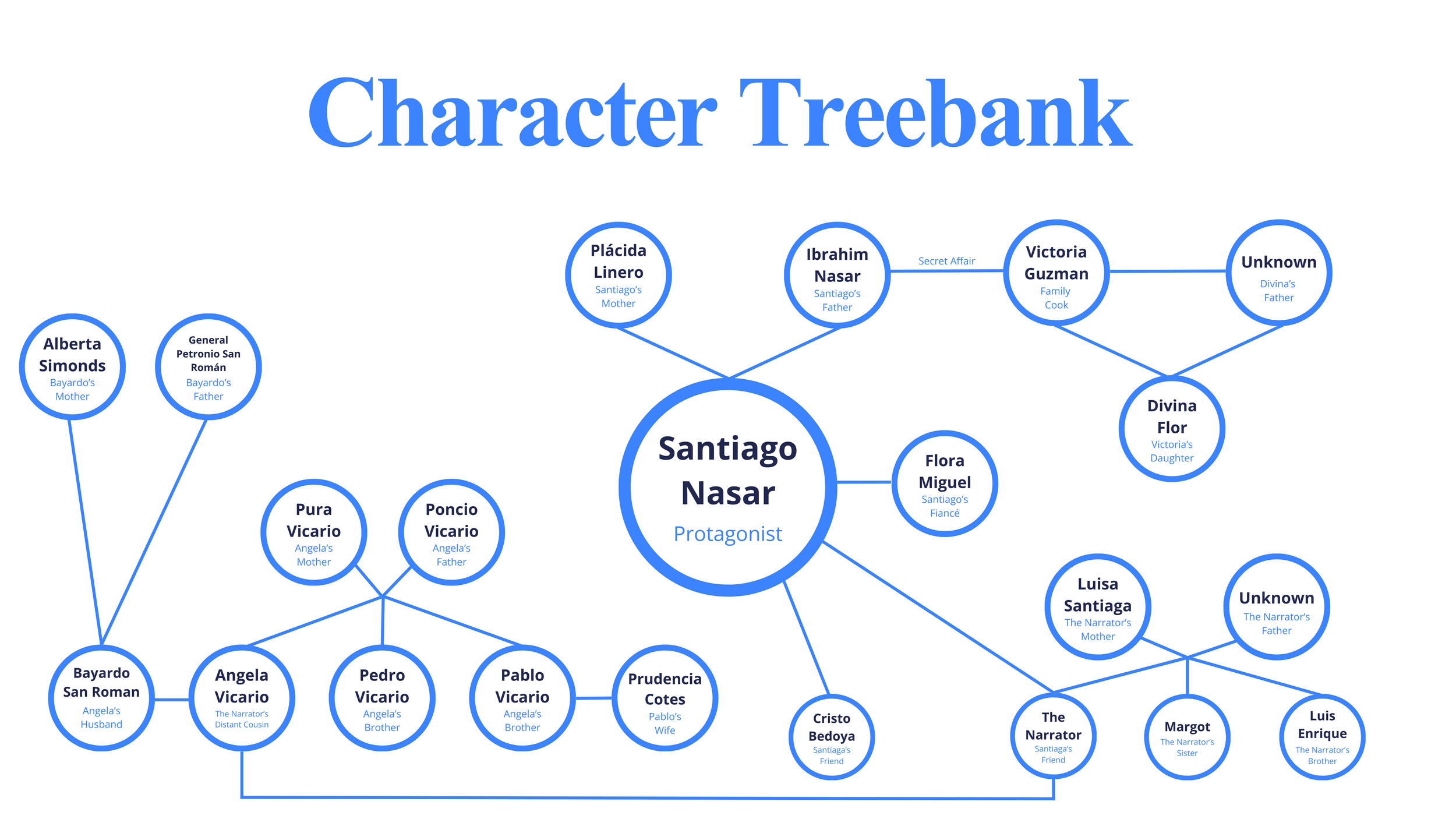
And because we are so kind, we’ve compiled an additional list of key characters you could consider: including their significance, their role in Nasar’s murder, and some key quotes you could use for your own essays.
Santiago Nasar
It would be a crime to write about the characters in the chronicle and fail to mention the star of the tragedy.
Santiago Nasar from the outset is characterised as a ‘sacrificial lamb’ in a purportedly necessary mission to preserve the honour code. Santiago is less of a ‘protagonist’ and more of a catalyst for exposing the dark underbelly of the township’s values.
Key moments to consider
The importance of whether Santiago is actually guilty of breaching the honour code. If Santiago is innocent, his death is a senseless tragedy; if Santiago is guilty, his death is a brutal consequence to say the least. Yet, regardless of this, what does this say about the culture of the society, and by extension, Marquez’s Colombia?
The scene with Divina Flor: his interactions with the cook’s daughter reveal a predatory side to Santiago’s character. This complicates our sympathy for him. Is he a ‘pure’ victim, or does his behaviour towards women reflect the very machismo that eventually kills him?
The significance of Santiago Nasar's dreams and his final moments before death. How do these dreams foreshadow his tragic end, and what might they symbolise about the futility of human attempts to escape fate?
Key quotes
“He grabbed my whole pussy.”
“...what had alarmed him most at the end of his excessive diligence was not having found a single indication, not even the most unlikely one, that Santiago Nasar had been the cause of the wrong.”
“On the morning of his death, Santiago Nasar hadn’t had a moment of doubt.”
“He dreamed he was going through a grove of timber trees where a gentle drizzle was falling” paralleling to “that at the moment of the misfortune a thin drizzle like the one Santiago Nasar had seen in his dream grove was falling.”
Angela Vicario
Angela Vicario is perhaps the most complex and enigmatic character in the novella. While Santiago is the victim of the physical act, Angela is the one who sets the entire machinery of death into motion. Angela was “the youngest daughter of a family of scant resources” and described as very beautiful.
Key moments to consider:
The credibility of her testimony and how quickly this warranted a sanction. By naming Santiago Nasar as the man who took her virginity, Angela provides the justification the twins need to carry out the murder. Yet, no time was taken to determine whether she was telling the truth. What does this say about the township’s values for the honour code over the legal system?
The social expectations Angela is subjected to. Angela is a victim of a society that places a woman’s entire value on her virginity (honour). What does this reveal about the role of women in 1950s Colombia?
The transformation of agency. Interestingly, Angela is one of the few characters who actually evolves. She begins as a passive, ‘meek’ girl, but matures into a woman who takes control of her own life. What does this say about the ability of women to carve their own paths?
Key quotes
“Angela Vicario…had been returned to the house of her parents, because her husband had discovered that she wasn’t a virgin.”
“The linen sheet with the stain of honour.”
“She became a virgin again just for him.”
“The fact that Angela Vicario dared put on the veil and the orange blossoms without being a virgin would be interpreted afterwards as a profanation of the symbols of purity.”
Pedro and Pablo Vicario
Pedro and Pablo Vicario are the ‘executioners’ of the novella, but there’s a layer of ambiguity as to their willingness to carry out this role. They appear as less individual personalities, and more as an extension of the society’s rigid honour code. As twin brothers, they act as a single entity, believing they are fulfilling their duty to restore their family’s honour.
Key moments to consider
The overall burden of manhood. The twins represent the heavy weight of machismo. To be a man in this society, they must avenge their sister’s lost honour, even if it means committing a murder against their conscience.
The justification of violence in the name of honour. Although violence is sanctioned in this world, even if it was a matter of honour, the silent consensus is that the punishment for such violence is a necessary sacrifice. What does this say about the morals of the society?
Whether Pedro and Pablo Vicario, too, are victims of the honour code. Although they assert that they’d commit the murder again in the name of honour, many of their actions also contradict this. What is your opinion?
Key quotes
“We killed him openly, but we’re innocent.”
“No matter how much I scrubbed with soap and rags I couldn’t get rid of the smell.”
“They would have done it again a thousand times over for the same reason.”
“She was certain that the Vicario brothers were not as anxious to fulfill the sentence as to find someone who would do them the favour of stopping them.”
“their reputation as good people” and as “a pair of big bluffers” that “look like children.”
Pura Vicario
As the mother of both the Vicario twins and Angela, Pura cements herself as the moral ‘engine’ of the tragedy. She is an aggressive enforcer of the town’s rigid gender roles, particularly seen through her methods of upbringing. She also represents the family’s obsession with appearances, prioritising honour over well-being in all facets.
Key moments to consider
The marriage negotiation. Pura is the one who pushes Angela to marry Bayardo San Roman, despite Angela not loving him. What does this say about not only Pura’s views on marriage, but the society in which she lives?
The beating of Angela. Is this violence more calculated or an emotional outburst?
The aftermath of the murder. Years later, when the narrator visits, Pura is read to have “rewritten” her family’s history to make themselves look like the victims of Santiago’s crime. What does this say about the fragility of the truth?
Key quotes
“Love can be learned too.”
“The brothers were brought up to be men. The girls had been reared to get married.”
“She was holding her by the hair with one hand and beating her with the other with such rage that she thought she was killing her.”
“She devoted herself with such spirit and sacrifice to the care of her husband and the rearing of her children that at times one forgot she still existed.”
“Any man will be happy with them because they’ve been raised to suffer.”
Prudencia Cotes
Prudencia Cotes is a relatively minor character in the chronicle, but she is thematically vital for understanding the town’s social expectations. She is introduced as the fiancee of Pablo Vicario. She waits for him to finish his prison sentence and eventually marries him after he is released. She is a firm believer of the honour code, and hence one of the most willingly complicit characters in Santiago’s murder.
Key moments to consider
Her blatant encouragement of the crime, particularly in comparison to the Vicario twins. How does Prudencia’s attitude change the way we view the Vicario twins - are they truly villains or are they simply victims of their culture’s expectations?
Key quotes
“I knew what they were up to…and I didn’t only agree, I never would have married him if he hadn’t done what a man should do.”
“Prudencia Cotes stood waiting in the kitchen until she saw them leave by the courtyard door, and she kept on waiting for three years without a moment of discouragement until Pablo Vicario got out of jail and became her husband for life.”