Mastering Miles Franklin’s My Brilliant Career

When I first read My Brilliant Career, I (a 21 year old from the 21st century) was shocked about how much I related with Sybylla, the novel’s protagonist. Her insecurities, her desires, her political beliefs — they were almost identical to my own. It was almost like I was reading a biography about my own life…
That’s why Franklin’s coming-of-age novel still holds up today; it’s relevant.
It follows the life of a young Aussie girl from rural New South Whales, whose childhood trauma has conditioned her to perceive herself as undesirable. Yet beneath her insecurities lies an ambitious, passionate young woman determined to shape her own destiny. She’s driven. She’s seeping with personality. She’s unapologetically herself.
If your school is studying My Brilliant Career, you’re in for a treat. Although I’ll admit some chapters drag on, it’s a really lovely story about love, female empowerment, and rejecting the identity that has been imposed upon us.
In this text guide, we have explored the context of the novel, broken down its key themes, and attached a sample essay, so you can spend less time researching and more time MASTERING your assessment. All the best!
Plot Summary:
In late 19th-century Australia, Sybylla Melvyn comes of age amidst severe financial instability within her family. Although she begins life in relative comfort, her father relocates the Melvyn family to Possum Gully in an attempt to pursue a career in stock trading. His failure forces the family into exhausting dairy farming, where relentless labour and hardship intensify Sybylla’s desire for self-determination and a life beyond rural limitations.
Frequent conflict with her mother leads to Sybylla being sent to Caddagat, the estate of her grandmother, Mrs Bossier. There, Sybylla is promised refinement and preparation for marriage, and she quickly becomes enamoured with its cultured environment. At Caddagat, she encounters Frank Hawden, a jackaroo, Harold Beecham, a neighbouring landowner, and Everard Grey, Mrs Bossier’s adopted son. Everard encourages Sybylla to pursue a career in the arts, but Mrs Bossier disapproves.
Sybylla’s relationship with Harold develops into a courtship, culminating in his marriage proposal, which she accepts impulsively. However, her discomfort becomes evident when she reacts violently to his attempt at intimacy, revealing her internal conflict regarding femininity and desire. Harold forgives her, and the engagement continues in secret. Their relationship is disrupted when Harold loses his fortune, yet Sybylla insists on maintaining their engagement and proposes a four-year separation before deciding their future.
Shortly after, Sybylla is forced to leave Caddagat to repay her father’s debt by working as a governess for the M’Swat family at Barney’s Gap. The household is marked by poverty, ignorance, and disorder, and Sybylla struggles to adapt to its lack of cultural and intellectual stimulation. Despite initial resistance from the children and household, she eventually asserts authority in her role.
Overwhelmed by isolation and dissatisfaction, Sybylla experiences a physical and mental collapse, leading to her return to Possum Gully. There, tensions with her mother intensify, and Sybylla is excluded from returning to Caddagat when her sister Gertie is sent instead. When Harold reappears after regaining his wealth, Sybylla rejects his renewed marriage proposal, believing he cannot understand her lived experience.
In the end, Sybylla remains unmarried and without clear prospects, reflecting on ambition, identity, and mortality. She ultimately embraces her Australian identity and the bush landscape, closing her narrative with a sense of resigned acceptance and national pride.
Context:
Historical Context:
Women's Suffrage in Australia:
In the Victorian era, women strived to uphold the role of a "true woman" by embodying four core virtues; piety, purity, submissiveness, and domesticity. They were expected to be Christian, sexually pure, and willing to fulfil household responsibilities, like cooking, cleaning, and caring for children. Their access to education was restricted, employment opportunities were limited, and right to vote was denied. After marriage, their husbands often gained control over their property, income, and legal identity.
However, the turn of the 20th century saw the rise of the "new woman" — an independent figure who challenged traditional gender roles by fighting for equality in education and the workplace. In particular, women called suffragettes fought for the right to vote by organising marches and rallies.
In 1894, in response to pressure from the Women’s Suffrage League and Woman’s Christian Temperance Union, South Australia was the first British colony to achieve women's suffrage. Soon after, the Commonwealth Franchise Act 1902 granted all non-Indigenous Australian women the right to vote. This was achieved one year after the release of My Brilliant Career in 1901.
Australian Nationalism:
Following the arrival of the First Fleet in 1788, Australia consisted of six self-governing British colonies, inhabited by settlers who considered themselves English. However, by the late 1800s, the settlers began forming a distinct national identity that set them apart from their British heritage. Unlike their European counterparts, Australians enjoyed manual labour, valued mateship, and developed a belief in fairness, equality, and egalitarianism.
This emerging culture culminated in the federation of Australia in 1901, when the six British colonies agreed to form a new nation, the Commonwealth of Australia. During this period, patriotism flourished as Australians took pride in their shared identity.
It is important to note, however, that this emerging national identity excluded Aboriginal and Torres Strait Islander communities, whose cultures predated colonisation by tens of thousands of years. The federation period entrenched policies that led to dispossession, assimilation, and prejudice, the effects of which continue to impact Indigenous communities today.
Authorial Context:
Miles Franklin:
Born in 1879 in New South Wales, Stella Maria Sarah Miles Franklin was a renowned Australian author, best known for writing All That Swagger, My Career Goes Bung, and, of course, My Brilliant Career.
In 1906, Franklin moved to the United States, where she worked as an editor and secretary for the Women's Trade Union League, an organisation that aimed to establish labour unions for women and improve the working conditions of sweatshops. In this position, she co-edited the league's magazine and continued writing novels.
After completing this work, in 1915, Franklin moved to England to work as a cook, pursue a career as a journalist, and serve as a nurse in World War I. She returned to Australia in 1927, where she continued writing, until her death in 1954.
Authorial Intent:
Feminism:
At its heart, My Brilliant Career advocates for a world in which women have the power to determine their own destiny. Franklin endorses women who aspire to pursue a career, reject restrictive institutions, and refuse to exhibit traditionally feminine attributes, like politeness, modesty, and domesticity. Yet, being a realist, she does not gloss over the disrespect, discrimination, and pushback women may receive from their circle when deviating from the gender roles society expects them to adhere to.
Patriarchy:
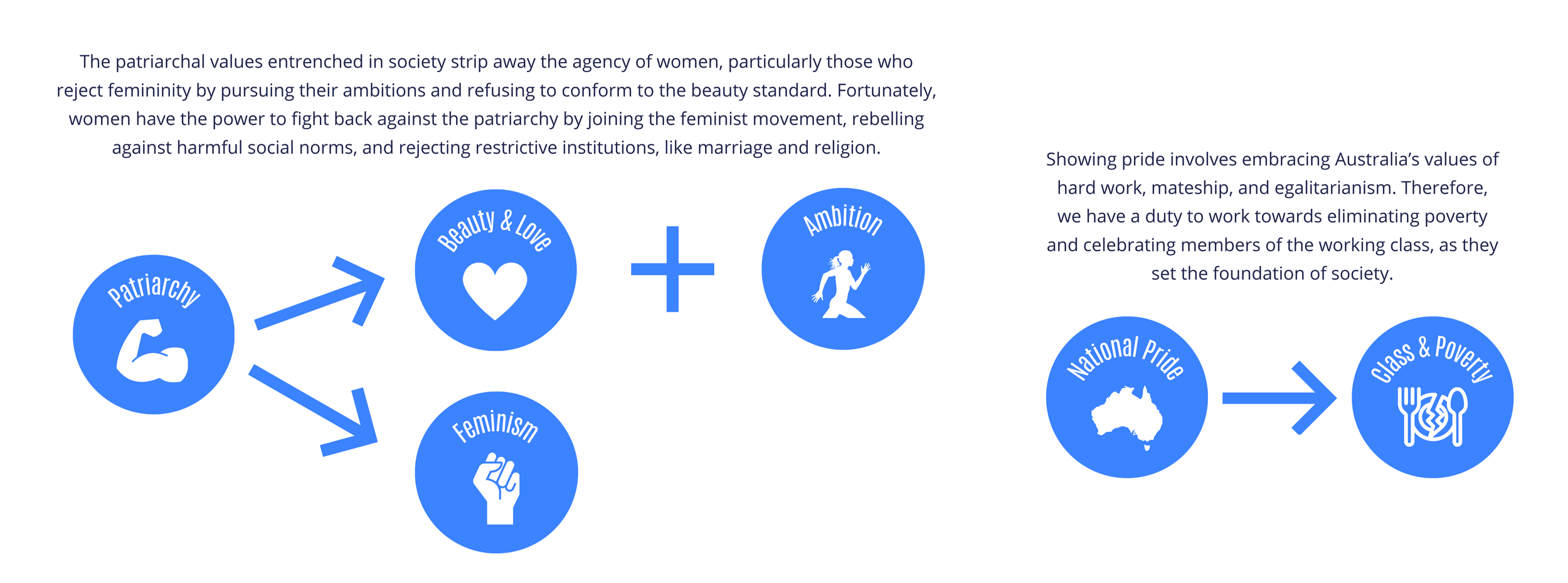
Franklin vehemently denounces the patriarchal norms deeply rooted in Australian society in the 19th century. She heavily scrutinises the laws, systems, and institutions—like religion and marriage—that provide men with the power to oppress women, causing them to exhibit toxic traits, such as pride, violence, entitlement, and domination. However, like women, men are not confined to their role in society and have the capacity to challenge the patriarchy, demonstrate healthy masculinity, and respect women by backing their fight for equality.
Beauty & Love:
Franklin condemns the rigid beauty standards, perpetuated by the patriarchy, for causing women to develop insecurities — low self-esteem, fear of judgement, and a feeling of undesirability. These insecurities may run particularly deep amongst women, like Sybylla, who were not exposed to love in their childhood, potentially causing them to experience trauma and reject romance entirely.
Ambition:
Franklin conveys that pursuing one's dreams and aspirations is key to living a meaningful life. She suggests that the arts industry is particularly fulfilling, as it promotes self-expression, empowering people to seek self-actualisation. Despite this, she recognises that ambition is a curse for women, as it contradicts their role in society, exposing them to discrimination.
Class & Poverty:
Franklin showcases the gruelling physical labour undertaken by the working class in 19th-century Australian society. She celebrates their resilience, self-reliance, and grit, arguing that they form the backbone of civilisation. In contrast, she subtly critiques the upper class, depicting them as conceited, disrespectful, and detached from the realities of everyday life.
Australian Pride:
Franklin promotes those who take pride in Australia's emerging national identity by embracing our values of discipline, mateship, and egalitarianism.
Narrative Elements:
Form — Novel.
Genre — Bildungsroman. Conventions and features include: loss, journey, personal growth, internal conflict, and maturity.
Setting — The late 19th-century in rural Australia.
Focalisation — Focalised through the perspective of Sybylla Melvyn, a young Australian woman.
Tense — Past tense.
Person — First person.
Motifs:
Unreliable Narration — though Sybylla does not deliberately fabricate the truth, she often exaggerates her ugliness and misinterprets how others perceive her.
Epistolary Narrative — the letters highlight Sybylla's distance from the people she loves.
Marriage — marriage, with its restrictive nature, symbolises the systems and institutions that men use to oppress women.
Mirrors — by banning herself from looking in the mirror, Sybylla's self-confidence improves drastically, demonstrating that all women can grow to love themselves.
Hair — even though Sybylla is self-conscious of her hair, she is eventually able to appreciate its beauty, demonstrating that all individuals have the capacity to love themselves.
The Broken Harness — while driving a cart, Sybylla's harness breaks, representing how she is breaking free from the confines of societal expectations.
Heat Imagery — Franklin utilises tactile imagery of hot wind and scorching heat to physically represent the ferocity of Aussie droughts.
Nature Imagery — Franklin paints a vivid picture of the Aussie bush—gum trees, kookaburras, wattle blossoms—to evoke national pride.
Settings —
Bruggabong — Sybylla holds fond memories of Bruggabong, rendering it a symbol for childhood innocence.
Possum Gully — In Possum Gully, The Melvyn Family dedicate their entire lives to working tirelessly on the dairy farm, emphasising the physical and psychological turmoil endured by the working class.
Caddagat — Caddagat provides Sybylla with the opportunity to enhance her artistry, pursue her ambitions, and find romance, serving as a symbol for privilege.
Barney's Gap — In Barney's Gap, Sybylla yearns to return to Caddagat as she is disgusted by the M'Swat Family's filth, ignorance, and lack of refinement; it thus represents Australia's rejection of intellectualism.
Prompt Bank:
"…I in my crushed white muslin dress was as overshadowed as a little white handkerchief…" ‘My Brilliant Career suggests that comparison is the thief of joy.’ Discuss.
How does My Brilliant Career represent what it means to be Australian?
"…the social laws are so arranged that a woman’s only sphere is marriage…" ‘In My Brilliant Career, marriage is depicted as a restrictive and hollow institution.’ To what extent do you agree?
‘My Brilliant Career celebrates female empowerment.’ Discuss.
"I make no apologies for being egotistical…" ‘My Brilliant Career demonstrates that pride is more empowering than oppressive.’ Do you agree?
How does My Brilliant Career condemn the patriarchy?
"I am proud that I am an Australian, a daughter of the Southern Cross, a child of the mighty bush." ‘At its core, My Brilliant Career is about national pride.’ To what extent do you agree?
‘In My Brilliant Career, the characters value personal integrity over wealth’ Do you agree?
"Career! That is all girls think of now, instead of being good wives and mothers and attending to their homes and doing what God intended." ‘In My Brilliant Career, the characters fear modernity because it threatens stability.’ Discuss.
‘My Brilliant Career explores the curse of female drive and intellect.’ Discuss.
Exemplary Essay:
"At its core, My Brilliant Career is an exploration of Australian identity." Discuss.
Set in the pre-federation era, where British settlers were actively shaping their national identity, Miles Franklin's 1901 romance novel My Brilliant Career follows Sybylla, a fiercely rebellious young girl eager to break the cycle of poverty and pursue a career in the arts. Franklin depicts the taxing manual labour performed by the working class, arguing that pastoralists and labourers are invaluable to Australian society. In doing so, Franklin denounces classist individuals, arguing that they fail to uphold our egalitarian values as a nation. Hence, at its core, Australia celebrates hard work, commemorates blue-collar workers, and promotes equality for all.
Franklin communicates the idea that manual labour takes a physical and mental toll on Australian farmers. In the exposition, the Melvyn family are likened to sheep who have "shorn [themselves] of all bare necessaries of life." Here, the use of the adjective "all" highlights the extent to which they are deprived of basic resources, indicating that farmers are expected to sacrifice their comfort and stability in order to fulfil their responsibilities. This erodes their humanity, causing them to feel a sense of shame and worthlessness, as reflected when Sybylla describes Possum Gully "dimming the outside polish" of her family. In doing so, Franklin underscores that they have tarnished their reputation, indicating that manual labour not only causes physical pain, but psychological turmoil amongst hardworking pastoralists. This is particularly the case for labourers experiencing the "heavy hand" of poverty, as their access to essential supplies is further restricted. Here, by employing personification, Franklin suggests that poverty is not a passive backdrop, but a strong, stubborn force that directly shapes the lives of farmers. As such, she invites her readers to appreciate their work and recognise the value they provide to Australian society.
Therefore, Franklin emphasises that the working class are the backbone of civilisation. As she works on her father's farm in Possum Gully, Sybylla wallows in self-pity, complaining about "slaving and delving from morning till night." Here, Franklin hyperbolically depicts the manual labour undertaken by the working class as relentless, suggesting that it consumes their lives. Yet simultaneously, Sybylla is proud to be an Australian pastoralist who "fights" with the "stubborn independence of [her] British ancestors," indicating that she is not critiquing labourers, but the psychological turmoil they endure. In fact, she places farmers on a pedestal, perceiving them as the metaphorical "bulwark of every nation" who provide food security, contribute to the economy, and epitomise what it means to be Australian. In this passage, the use of the noun "bulwark," with its associations of stability, implies that the working class set the foundation for society, providing the framework that enables all industries to thrive. This is reinforced when Sybylla figuratively likens pastoralists to the "bone and muscle of [her] nation," revealing that they are not merely valuable to the economy, but are physically woven into the very fabric of Australia. Just as a body cannot survive without its structural core, our country cannot function without the hardworking farmers who work tirelessly to produce and sustain the resources that society depends upon. Ultimately, by idolising blue collar workers, Franklin suggests that all Australian citizens ought to respect them by appreciating the value they provide.
Accordingly, Franklin condemns classism, suggesting that prejudice is incompatible with our egalitarian values as a nation. This is perfectly encapsulated through the church in Possum Gully that segregates "commoners" from "aristocrats" as "skilfully as an expert horse dealer can draft his stock at a sale." By drawing this comparison, Franklin suggests that the church does not merely enable classism, it actively enforces it by separating the community along class lines. Those who "earn their bread by the sweat of their brow" are "pushed away to the corners," physically representing the discrimination they face in their day-to-day life. To Franklin, the treatment of labourers is contradictory, as Australia prides itself on providing equality for all members of society. This irony is reflected through Sybylla herself who holds the egalitarian belief that the "cripple is equal to the giant," yet views the M'Swat children as the "dirtiest urchins [she has] ever seen." Although the family are wealthy, they possess a low social status due to their poor reputation, rendering Sybylla's comments a form of classism. Hence, Sybylla represents the contradictory nature of Australians who align themselves with their national identity, yet refuse to promote social equality. At the M'Swat household, Sybylla is emotionally unstable and fundamentally flawed, positioning readers to challenge her behaviour and recognise that Australian identity consists of one key principle: giving everyone a fair go.
Ultimately, Franklin highlights the demands of physical labour, suggesting that farmers play a vital role in shaping Australian society. In doing so, she criticises people who harbour prejudice towards blue collar workers, arguing that they contradict our egalitarian values as a nation. Thus, at its heart, My Brilliant Career is a celebration of what it means to be Australian. It encourages us to value hard work, appreciate the working class, and promote equality for all individuals.