Mastering Shirley Jackson’s We Have Always Lived in the Castle

In contemporary society, we are becoming increasingly aware of the power structures that permeate every facet of human existence. They are ingrained in our institutions. They are embedded within our language. They are entrenched in our subconscious mind.
This is why marginalised communities are still fighting for social justice — although the law prohibits discrimination, they still don’t have access to the same degree of power, as an individual in a position of privilege.
Fundamentally, this is what We Have Always Lived in the Castle is all about — the importance of dismantling the power structures within society that oppress minorities (e.g. patriarchy, inheritance hierarchies, etc.). Shirley Jackson argues that human beings are inherently cruel and unjust; therefore, we can’t merely reform civilisation, we need to uproot the institutions that sustain prejudice in the first place.
In this blog post, we have put together everything you need to excel at your assessment: a plot summary, prompt bank, exemplary essay, and much, much more! I hope you enjoy delving into Jackson’s gothic novella and wish you the best of luck for your SAC!
Plot Summary:
We Have Always Lived in the Castle by Shirley Jackson is a gothic novel narrated by Mary Katherine “Merricat” Blackwood, an eighteen-year-old girl who lives in near-total isolation with her older sister Constance and their uncle Julian in a large house on the edge of a hostile village.
Six years earlier, most of the Blackwood family died after arsenic was put in the sugar at dinner. Constance was tried for the murders and acquitted, but the villagers remain convinced of her guilt and treat the sisters with cruelty and suspicion. Since then, Constance has refused to leave the house, while Merricat takes on the task of shopping in the village, where she faces open mockery. Merricat copes with fear and anger through elaborate magical rituals meant to protect the house and punish perceived enemies.
The sisters’ fragile routine is disrupted by the arrival of their cousin Charles, who is interested in the family’s remaining money and attempts to assert control over the household. His presence exposes tensions between the sisters and threatens their insular way of life. Merricat, viewing Charles as a mortal danger, sabotages him, but her actions lead to a fire that partially destroys the house.
In the aftermath, the villagers—once openly hostile—help extinguish the fire but then turn destructive, vandalising the home in a chaotic release of long-suppressed resentment. Charles leaves, and Uncle Julian dies shortly afterward. Constance and Merricat retreat into the undamaged part of the house, cutting themselves off almost entirely from the outside world.
By the novel’s conclusion, the sisters live in deliberate isolation, sustained by mutual devotion. It is revealed that Merricat, not Constance, poisoned the family years earlier. The novel closes on their strange, self-contained existence.
Context:
Historical Context:
Second Wave Feminism:
During World War II, because a significant proportion of the male population were serving in the military, women were encouraged to join the workforce — they manufactured weaponry, maintained food production, and entered the healthcare industry. However, once the war ended in 1945, women were expected to exit the workforce and return to their traditional stay-at-home duties. While some women embraced returning to their domestic roles, others resented losing their independence and autonomy.
Following this, the French writer, Simone de Beauvoir, wrote a book in 1949 titled, 'The Second Sex,' which challenged the idea that women were inherently inferior to men. This was followed by Betty Friedan's 1963 novel, 'The Feminine Mystique,' which critiqued those who believed that women could only be fulfilled as stay at home mothers or housewives. These two influential texts, coupled with the inception of the Civil Rights movement, led to second wave feminism, a powerful movement where women began challenging gender roles and advocating for equality.
Shirley Jackson's 1962 'We Have Always Lived in the Castle' clearly reflects these feminist conversations, given that the Blackwood sisters reject symbols of masculinity, such as money and nuclear family, and seek to create a life for themselves where they can embrace their independence.
The Witch Hunts of the Renaissance Period:
Beyond commenting on the second wave of feminism, Jackson also alludes to witch hunts in her novel, which were historically used by men in the 14th to 18th century as a means of oppressing women. Essentially, whenever a woman was outspoken or independent, authorities would label them as witches so they could justify persecuting and executing them. This served to instil fear in women, limiting their autonomy and pressuring them to submit to their subservient roles.
We see this oppressive practice in 'We Have Always Lived in the Castle,' when the townspeople persecute the Blackwood family. Though they don't explicitly label Merricat as a witch, they do create rumours about the Blackwoods to justify hunting them down, just like villagers would accuse women of practicing witchcraft to justify persecuting them during the Renaissance period.
Authorial Context:
Shirley Jackson:
Shirley Jackson is an American novelist who was born in San Francisco in 1916. As a child, Jackson enjoyed storytelling and aspired to become a writer. To achieve her dream, she began publishing both fiction texts and non-fiction editorials in campus magazines, where she condemned prejudice and championed marginalised groups such as Jewish and Black people.
In her 20s, Jackson married Stanley Hyman, an American literary critic. Whilst Hyman initially loved Jackson, he began sleeping around with women. In addition, even though Jackson was the chief breadwinner in the marriage, Hyman forced Jackson to do the cooking and cleaning, prohibited her from spending money and, in doing so, ripped away her independence.
As a writer, Jackson aimed to entertain her readers. Typically, in her novels, she constructed a pessimistic world in which the side characters were cruel and malignant. Her protagonists, who were often young women, were usually victims and isolated in some way.
In the final stages of her life, Jackson developed agoraphobia, anxiety, and obesity. She died in 1965 at age 48 due to heart failure.
Authorial Intent:
Isolation:
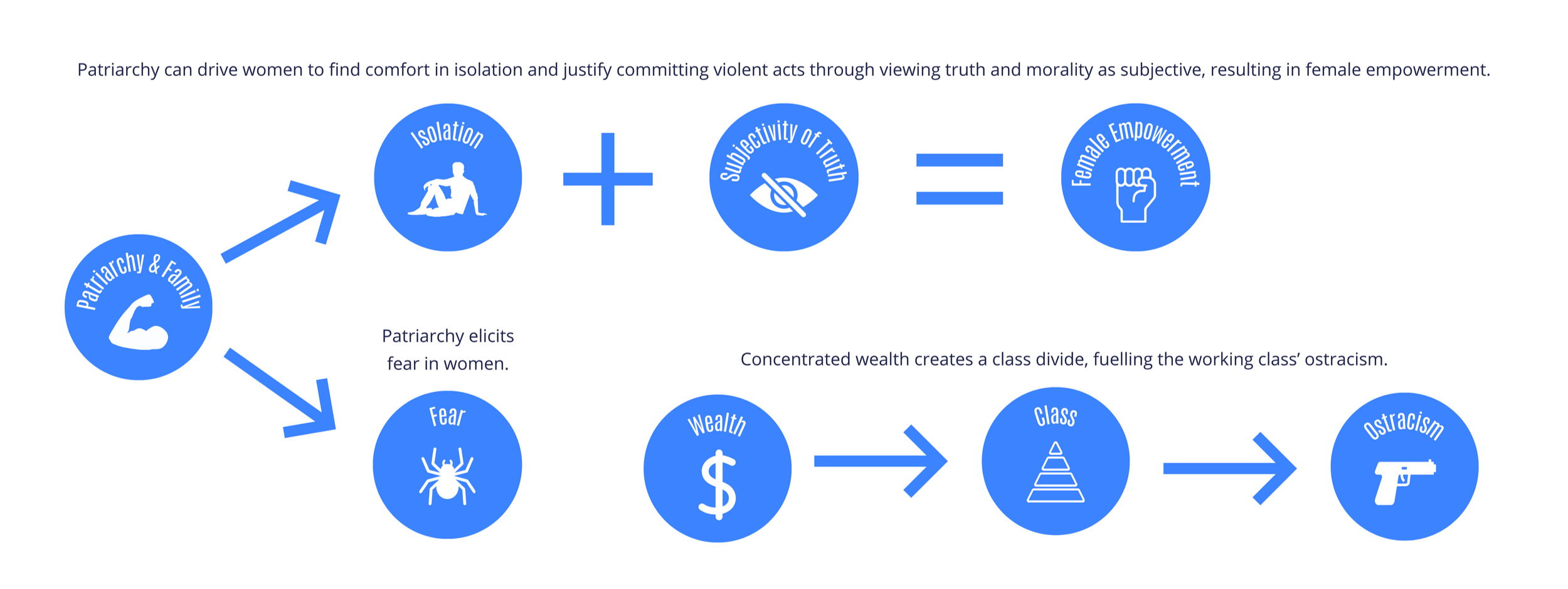
The cruelty of mankind drives women into isolation, so they can reject harmful societal norms and expectations they do not align with. Rather than eliciting fear or loneliness, isolation allows them to imagine and construct a world in which they possess the autonomy to determine their own choices in life. Therefore, Jackson views isolated environments as a powerful coping mechanism for marginalised communities in oppressive societies. Simultaneously, Jackson illustrates the dangers of being completely cut off from civilisation — it can exacerbate one’s anxiety and delusions, prompting them to rationalise and normalise committing violent acts.
Female Empowerment:
Women, in our patriarchal society, are driven to take extreme measures to reclaim their agency — they completely cut off society to dismantle the power structures that rob them of their independence, construct unconventional family structures to avoid being oppressed in the domestic sphere, practise black magic to protect female spaces, and violently eliminate androcentric men who uphold the patriarchy and exhibit traits of toxic masculinity. Imbuing nuance into the conversation, Jackson simultaneously depicts women who find empowerment by embracing traditional ideals of femininity. Therefore, she does not critique womanhood, but the gender roles that force them to fulfil certain roles in society.
Patriarchy & Family:
Jackson portrays a patriarchal world that awards immense power to men, while denying women the independence and agency they deserve. This creates a power imbalance, driving traditional men to take advantage of women by restricting their finances, prohibiting them from entering the workforce, and reducing them to their domestic duties. The oppression of women is intensified in nuclear families, as they reinforce patriarchal structures and the unequal division of labour.
Fear:
Jackson represents fear as a powerful tool for marginalised communities, as it warns them of the inherent danger and toxicity in repressive societies. Although the anxious characters may seem melodramatic, their concerns are ultimately warranted, given the townspeople erratically vandalise and destroy the Blackwood mansion. That said, those who are entirely governed by fear may experience agoraphobia, regressing their social skills, and obstructing their aspirations.
Subjectivity of Truth:
Since truth is a social construct, when individuals are physically isolated from civilisation, they are able to create their own reality — women can grant themselves authority, spiritual folk can believe in the existence of black magic, and misanthropists can imagine a world devoid of mankind. However, with the subjectivity of truth comes the relativity of morality, as we cannot develop universal principles if we have access to different information. For instance, if a person genuinely believes that they did not commit murder, then they cannot hold themselves morally accountable. This can consequently drive people to continue committing crimes and transgressing ethical frameworks, eliminating any possibility of self-improvement.
Wealth & Class:
In a true capitalist economy, the government does not redistribute wealth inherited within families or accumulated by profit-motivated businesses, widening the divide between the lower and upper class. This inequality, according to marxist theory, will intensify over time, leading to class consciousness, where workers will recognise their collective oppression. In her novel, Jackson depicts a capitalist economy, in which one affluent family—with generational wealth—isolates themselves from the working class. This creates tension and resentment, ultimately driving the poor majority to start a revolution in an attempt to overthrow the entire system. Jackson therefore suggests that the deconstruction of capitalism and redistribution of wealth is inevitable.
Ostracism:
In a capitalist, patriarchal society, ostracism and social exclusion are unavoidable. This is because men will naturally alienate women who refuse to uphold gender roles and the poor majority will inevitably distance themselves from the upper class, due to their conflicting interests. Even though ostracism is a product of oppressive power structures, Jackson does not endorse this exclusive behaviour, but highlights the psychological pain it can evoke within all parties — victims may experience loneliness and despondence, while culprits may feel guilty or shameful.
Narrative Elements:
Form — Novella.
Genre — Gothic. Conventions and features include: isolation, haunted house, the supernatural, ghosts, the uncanny, a sense of foreboding.
Setting — A secluded mansion in a small American village.
Focalisation — Focalised through the perspective of Merricat, an 18 year old woman who poisoned her family as a child.
Tense — Present tense.
Person — First person.
Motifs:
Unreliable Narration — Merricat’s untrustworthiness illustrates the subjectivity of truth and relativity of morality.
The Moon — the moon, being physically distant from civilisation, is widely considered a symbol for isolation.
Blackwood Mansion — the Blackwood mansion, being a feminine utopia, symbolises female empowerment.
Food (sugar bowl, jars) — food is synonymous with power, as Merricat weaponises it to re-gain her authority in the patriarchy.
The Safe & Money — husbands have historically restricted their wives’ access to money as a means of controlling them. However, only Constance and Merricat have access to the safe, thus demonstrating the reversal of gender roles within the confines of the Blackwood estate.
Dresden Figurine — the Dresden figurine symbolises female resilience, as it withstands the vandalisation of the Blackwood mansion.
Gothic Allusions (demons, witches, vampires) — Merricat likens Charles to gothic creatures to highlight his evilness and monstrosity. Additionally, Merricat has reclaimed the role of a witch, as practicing black magic allows her to find solace.
Colour — Merricat describes the village devoid of colour to demonstrate the hopelessness and cruelty of society.
Domestic Rituals — although Merricat has rejected gender roles, she enjoys performing a number of domestic duties, possibly demonstrating how societal expectations are deeply entrenched in all women, even feminists.
Fire — Merricat’s fire rids the Blackwood mansion of her parasitical family members, transforming it from a fear inducing environment, to one of tranquility.
Broken Step — Joe Dunham and Charles both fail at mending a broken step at the Blackwood mansion, demonstrating that one’s gender does not automatically dictate their abilities.
Prompt Bank:
"…I wished they were dead... I was never sorry when I had thoughts like this; I only wished they would come true." 'In We Have Always Lived in the Castle all characters are equally cruel.' To what extent do you agree?
How does We Have Always Lived in the Castle critique mob mentality?
To what extent does We Have Always Lived in the Castle show that truth is subjective?'
‘We Have Always Lived in the Castle advocates for a world in which people are empathetic.' Discuss.
"I am living on the moon." 'We Have Always Lived in the Castle emphasises the importance of one's imagination.' Do you agree?
‘To what extent does We Have Always Lived in the Castle celebrate female power?'
'The characters are both heroes and villains in We Have Always Lived in the Castle.' Discuss.
'We Have Always Lived in the Castle suggests that the objective truth is not nearly as important as one's perception of their reality. To what extent do you agree?
‘Family is the cause of all the problems in We Have Always Lived in the Castle.’ Do you agree?
“There’s a change coming.” ‘We Have Always Lived in the Castle suggests that change is never positive.’ To what extent do you agree?
Exemplary Essay:
To what extent is the fear in We have Always Lived in the Castle justified?
Fear is ubiquitous within oppressive systems that seek to eradicate individuality. Reflecting the rigid social norms of the postwar era, Shirley Jackson's 1962 gothic novella We Have Always Lived in the Castle explores two sisters whose lives are infiltrated by their patriarchal cousin. Set amongst the backdrop of a conservative village eager to limit the agency of modern women, Jackson explores how the fear felt by the female characters is entirely justified, as traditional men tend to threaten those who refuse to participate in a system that fuels their power. As such, being afraid is not solely rational, but an inevitable product of oppression itself.
Setting the foundation to explore the pervasiveness of fear, Jackson critiques the gender roles deeply rooted in 1960s America, as exemplified through Helen's maternalistic relationship with Constance. Embodying traditional notions of femininity, Helen feels responsible for the wellbeing of Constance because she has been socialised to perform domestic duties and embrace motherhood. In particular, she consistently attempts to convince Constance to "come back into the world" as she has a "right to be happy," reflecting her maternalistic desire to guide, nurture, and express compassion. In this moment, Jackson's use of an imperative mood highlights that Helen is in a position of authority, mirroring the didactic dynamic in mother daughter relationships. Subconsciously realising this herself, Merricat imagines Helen sitting in "branches", figuratively implying that she is connected to the Blackwood family tree due to the motherly role she has fulfilled. Whilst Helen's intentions are not made explicit, the traditional values entrenched within the village indicate that she is not innately maternalistic, but merely conforming to rigid gender roles that force her to adopt a self-sacrificing, caregiving identity. These roles are made apparent through Jackson's sociological observations, in which she juxtaposes "men [staying] young," against "women [aging] with grey evil weariness," exposing how the female villagers are disproportionately burdened by emotional labour and domestic responsibilities. Therefore, providing a social commentary on the domestic sphere of the 1960s, Jackson challenges the societal norms that force women into a predetermined identity, exploring how rapidly fear can spread in such an oppressive environment.
Therefore, the fear embodied by independent women is justified. Merricat refuses to adhere to the village's restrictive gender expectations, instead opting to assert her individuality, as embodied through her unorthodox mental landscape. Blurring the line between fantasy and reality, she seems to legitimately believe she has magical capabilities to "fly to the moon" on her "winged horse," metaphorically reflecting the deviance of women in the 1960s who rejected the status quo by entering the workforce or delegating their domestic obligations. Merricat's independence, however, is incompatible with femininity, given she is unjustly treated by the townspeople for refusing to uphold ladylike manners in the public sphere. In Stella's CAFÉ, Merricat refuses to converse with Jim Donnel, prompting him to "stretch out [his legs] so [she can] not get past him." Here, he is punishing Merricat for asserting autonomy and refusing male authority, which creates tension, reflecting her sense of dread and discomfort in the scene. This ultimately drives her to hastily return home, "securely fastening [the padlock] behind [her]." Merricat's fear is not unreasonable, but a perfectly logical response to the danger imposed by conservative men attempting to re-gain control over women dismissive of the patriarchy. These threats merely intensify at the novel's climax, where Jim "smashes a rock through one of the great tall windows of [the] mother's drawing room." He deliberately targets a feminine space—culturally associated with hospitality and domesticity—to symbolically dismantle Merricat's power as a self-sufficient, modern women, further justifying her fears and anxieties.
Fundamentally, however, the fear in We Have Always Lived in the Castle is not merely justified, but a product of Jackson's oppressive society. Charles—another character who embraces traditional gender roles—is not merely a threat to the Blackwood family's acentric lifestyle, but their financial stability. Paying homage to one of the most widely recognised gothic tropes, Jackson figuratively likens Charles to a vampire — he is a parasitic intruder, likened to a "demon," who only enters the mansion after being invited. However, rather than draining the sisters of blood, he drains them of wealth, as illustrated when he scolds Merricat for burying the family's silver dollars in the garden. Viewing her behaviour as "outrageous," he passionately believes "she has no right to hide" the family's money, as if he himself owns a share of their assets. This, coupled with his domineering tone, naturally prompts Merricat to feel apprehensive about Charles' perceived ownership of her family's fortune, as men have historically stripped women of their financial freedom to gain control — to Merricat, it's not a possibility that Charles will limit the Blackwood sister's access to money, but an inevitability. Therefore, the anxiety embodied by Merricat is not only reasonable, but a visceral reaction to the structural forces that empower men to dominate women’s lives. This is perfectly encapsulated through her instinctive belief that a "change [is] coming," which foreshadows Charles' arrival to the Blackwood estate. In this regard, fear is not solely an emotional response to danger, but a form of intuition for marginalised communities in unjust societies.
Ultimately, within the confines of a conservative village that seeks to limit modern female agency, Jackson demonstrates that fear arises both reasonably and inevitably from oppression, as traditional power structures endanger those who resist their authority. Jackson therefore encourages her readership to appreciate their anxiety for warning them about the inescapable danger of the patriarchy — it is not a restrictive force, but a tool that can be leveraged to maintain one's safety and security.