Mastering Stephen Johnson’s High Ground

Most of us like to believe we’d take the high road… until we’re actually tested.
It’s easy to talk about integrity when nothing’s on the line. But what about when your teacher marks your essay unfairly? Or when your best friend starts a rumour about you? Sometimes, it is difficult to be a good person, because the world is inherently cruel and unjust. Women are underrepresented in the workplace. Aboriginal Australians are overrepresented in the criminal justice system. And minorities are still, in the 21st century, discriminated against on the basis of race, gender, class, and sexual orientation. So, why should you maintain your integrity if you are a victim of oppression? This is the question Stephen Johnson’s 2021 Revisionist Western Film, “High Ground,” asks us to contemplate.
If you’re studying this confronting, yet cinematically beautiful film, you’re in luck. I’ve put together EVERYTHING you will ever need to EXCEL at your text response SAC. I’m talking plot, context, authorial intent, narrative elements, motifs, prompts, and a sample essay. All the best!
Plot Summary:
The film opens to a vast landscape in Arnhem Land, Northern Australia, in 1919.
It begins with the massacre of an Indigenous tribe during a Christian missionary trip. Only two survive: a young Gutjuk and his uncle, Baywara. Gutjuk is “saved” by Travis, while Baywara’s father returns to the site and tends to his son.
Twelve years later, the audience is introduced to the East Alligator Mission Outpost, where Gutjuk and other Indigenous Australians are residing, with Claire and Braddock overseeing the site. Baywara has gathered a mob of Indigenous Australians, retaliating against colonial violence.
Gutjuk and Travis are sent out to find the mob and capture Baywara. However, Travis is ambushed and captured by members of the mob. After some discussion, Grandfather Darrpa and a group of Indigenous tribe members decide to seek negotiations for Baywara’s freedom. During negotiations, it is revealed that Baywara’s mob has carried out another attack, and the negotiations fall apart.
The Indigenous tribe returns to their home. Gutjuk reunites with Baywara, suggesting that guns are necessary to win the fight. Baywara does not take these suggestions lightly and threatens him with a spear to prove a point. Travis, positioned on the mountaintop ready to shoot, fires his gun when he sees this.
Near the end, Gutjuk enters the East Alligator Mission Outpost and confronts Travis. It comes down to a standoff between several characters, and Travis is ultimately shot. As the film closes, Gulwirri and Gutjuk slowly disappear into the distance while Claire sits beside the lifeless bodies of Travis and Eddy. Nothing is resolved, and relationships between Indigenous and non-Indigenous Australians remain tense. Trauma and resentment ultimately prevail, despite the efforts that have been made.
Context:
Historical Context:
Post WW1 Australia:
‘High Ground’ is set in Arnhem Land, Northern Australia in 1919, immediately following the end of WW1. At the time of its setting, the ANZAC soldiers had recently returned from war, where all soldiers were considered equal on the field, irrespective of their ethnic background. Yet, upon return, this mutual respect was lost almost instantaneously.
The White Australia Policy:
However, preceding the war, ‘The Immigration Restriction Act 1901’ otherwise known as the ‘White Australia Policy’ was enforced. This policy reduced the number of non-European migrants entering Australia as a means of creating an Australia that was racially homogenous. This is reflected through the racist beliefs and Eurocentric values rooted within the white characters in the film.
The Stolen Generations:
Furthermore, the film takes place during one of the darkest times of Indigenous history — the Stolen Generations. During this time, government bodies and churches forcibly removed Indigenous children from their families to assimilate them into white society.
Societal Context:
National Apology to the Stolen Generations:
In 2008, the then Prime Minister Kevin Rudd offered a formal apology to Indigenous Australians regarding the Stolen Generations. He expressed deep sorrow and remorse for the laws and policies of successive governments that had inflicted profound grief, suffering, and loss on Aboriginal and Torres Strait Islander peoples.
Indigenous Deaths in Custody:
In the years leading up to High Ground’s release, Indigenous incarceration rates were rapidly increasing, due to generational trauma and the government’s inability to close the gap. Despite a formal acknowledgement and apology, Indigenous communities remain severely impacted by colonisation.
Australia Day Protests:
Following the first year of the COVID-19 pandemic and the resurgence of the Black Lives Matter movement, public debate intensified surrounding the date of Australia Day. As January 26 marks the beginning of British colonisation, many Australians increasingly questioned the appropriateness of celebrating a national holiday on a day that signifies dispossession, violence, and cultural loss for Indigenous peoples.
Authorial Context:
Stephen Maxwell Johnson:
Stephen Maxwell Johnson spent his early years in the Bahamas before relocating to Africa and later Northern Australia. Growing up across diverse cultural landscapes, his childhood was deeply shaped by Indigenous communities in various nations and continents. In particular, his close connection with Indigenous Australians and their culture significantly influenced the conception and production of High Ground.
Through this proximity, Johnson developed a nuanced understanding of the enduring impacts of colonisation on Indigenous Australians. The stories shared with him — narratives of culture, resilience, dispossession, and violence — alongside witnessing the tangible intergenerational consequences of the Stolen Generations, fostered in him a profound awareness of historical trauma and its continuing effects.
In an interview with Sadie Dean of Script, Johnson explains that the film’s premise emerged from a convergence of personal accounts and the lived experiences of friends, woven together into a single narrative. Accordingly, High Ground presents a multiplicity of Indigenous perspectives, representing women, children, warriors, men, and individuals of mixed heritage who are positioned between the worlds of the colonisers and the colonised.
Authorial Intent:
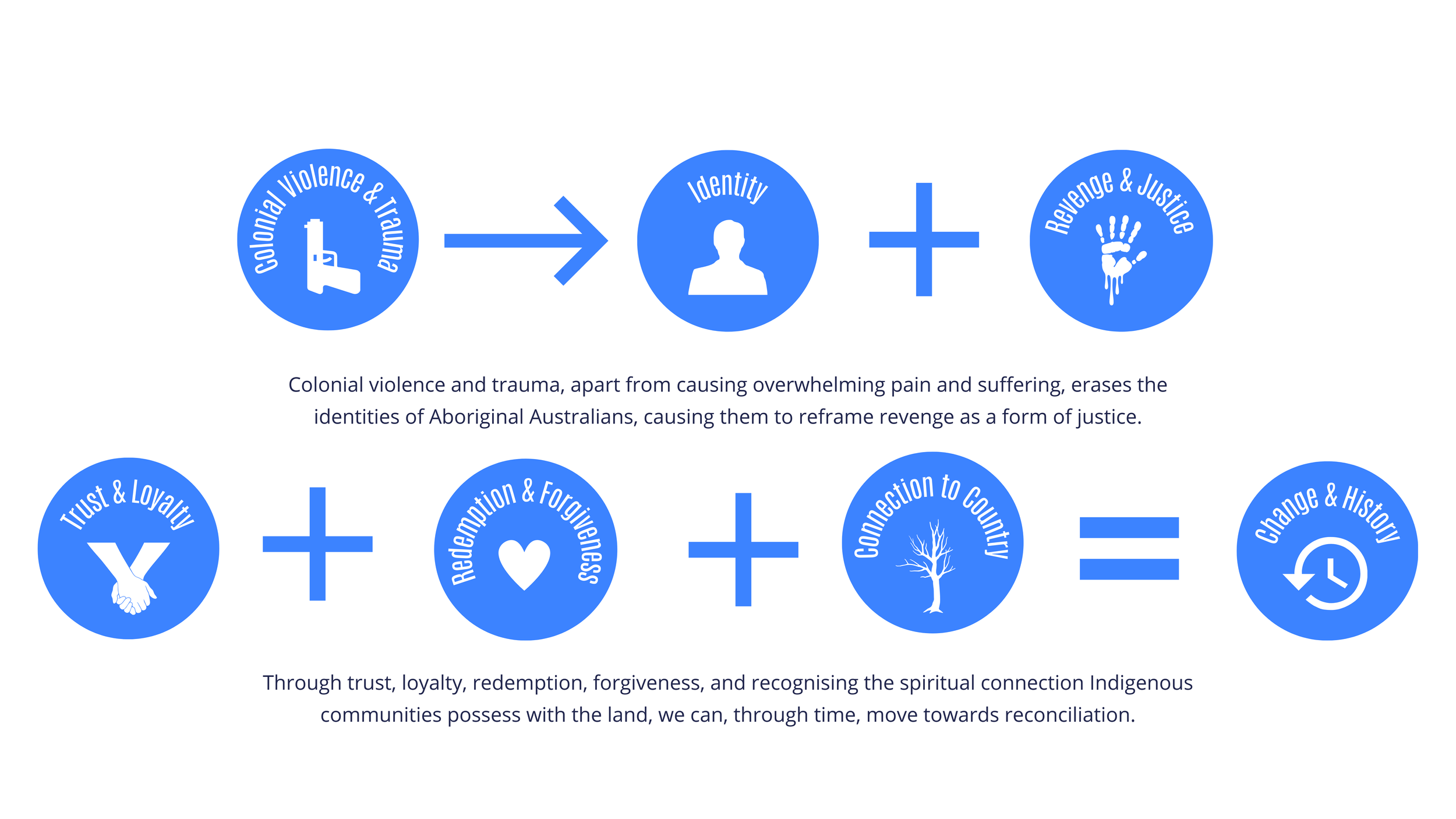
Colonial Violence & Trauma:
The brutality of colonial expansion irreparably fractures Indigenous communities, embedding trauma that reverberates across generations. Johnson illustrates that violence is not confined to a singular historical massacre, but lingers psychologically, shaping identity, relationships, and perceptions of justice in the present. The landscape itself becomes a mnemonic device, carrying the scars of bloodshed and betrayal. Therefore, Johnson contends that colonial violence is not a closed chapter of Australian history, but an enduring wound that continues to inform contemporary racial tensions and cycles of retaliation.
Identity:
Johnson divulges that identity formation and allegiance to social groups are intrinsic aspects of human nature; individuals seek belonging as a means of survival and self-definition. However, when these identities are weaponised — through racial vilification, colonial hierarchies, and rigid binaries of “civilised” versus “savage” — they catalyse dehumanisation and cyclical violence. By humanising individuals on both sides of the frontier, Johnson critiques the reductive labels that sustain conflict. Ultimately, he asserts that the danger lies not in identity itself, but in the stigmatisation and moral absolutism imposed upon it.
Connection to Country:
Johnson emphasises that the Australian landscape is not a passive backdrop, but a living spiritual entity intricately bound to Indigenous culture, law, and cosmology. The flora and fauna function as extensions of identity and ancestry, reinforcing a custodial rather than possessive relationship with land. In contrast to colonial perceptions of territory as property to be conquered, Indigenous connection to Country is portrayed as reciprocal and sacred. Therefore, Johnson positions disconnection from land as both a cultural violation and a spiritual dispossession.
Revenge & Justice:
In a world governed by systemic injustice, revenge emerges as both a corrosive force and a mechanism for personal closure. Johnson underscores the destabilising consequences of retributive justice — it perpetuates division, deepens mistrust, and fractures any hope of collective unity. Yet, he simultaneously honours its emotional legitimacy, acknowledging that for those denied institutional justice, revenge can appear as the only viable reclamation of agency. Thus, Johnson presents revenge not as a moral solution, but as a tragic symptom of a society that has failed to equitably uphold justice for all.
Change & History:
While Johnson demonstrates that history possesses a cyclical quality — prejudice begetting violence, violence inciting retaliation — he simultaneously gestures toward the possibility of incremental change. Transformation does not manifest through sweeping institutional reform, but through subtle shifts in empathy, perspective, and moral courage. By illustrating characters who waver between complicity and conscience, Johnson suggests that although historical patterns are deeply entrenched, they are not immutable. Change, though fragile, remains attainable through conscious individual choice.
Trust & Loyalty:
In the volatile frontier landscape, trust and loyalty are revealed to be inherently precarious, easily fractured by fear, racial bias, and self-preservation. Johnson pinpoints that allegiance built upon power imbalances or unspoken resentment is destined to collapse. Yet, he proposes that mutual respect and empathy serve as the only viable foundations for reconciliation between settlers and Indigenous custodians. Consequently, trust is not portrayed as an inherent virtue, but as a fragile construct that demands consistent moral integrity to endure.
Redemotion & Forgiveness:
Johnson elucidates that redemption is not achieved through grand gestures of heroism, but through quiet, deliberate transformations in perception and conduct. Forgiveness, similarly, is not unconditional absolution, but a gradual relinquishment of hatred that allows individuals to transcend inherited cycles of violence. By centring moral growth within everyday choices — the decision to listen, to protect, to humanise the other — Johnson suggests that redemption is measured by sustained ethical change rather than performative acts of remorse. In doing so, he reframes forgiveness as an act of strength that disrupts, rather than perpetuates, historical trauma.
Narrative Elements:
Form — feature film.
Genre — Historical drama / Action / Revisionist Western. Conventions/Tropes include: morally ambiguous protagonists, sympathetic Indigenous perspectives, critiques of colonialism and frontier violence, graphic realism, corrupt or traumatised lawmen, harsh landscapes, and a deconstruction of the traditional “heroic frontier” myth.
Setting — The remote Arnhem Land region of the Northern Territory in 1919, during the frontier conflicts between Indigenous Australians and European settlers.
Focalisation — Primarily focalised through Travis.
Tense — Past.
Person — Third person.
Motifs:
Country — The vast Arnhem Land landscape symbolises Indigenous spiritual identity and continuity. Its serenity contrasts sharply with colonial violence, reinforcing that true belonging comes from connection to Country, not ownership.
Guns and weapons — The constant appearance of firearms represents colonial authority and the imposition of European legal traditions — Johnson frequently frames soldiers through their rifles, suggesting that violence underpins colonial control rather than morality.
The hawk and the snake — Gutjuk (which translates to “hawk”) and Baywara (which translates to “snake”) are both named after animals that rely on instinct and survival. This predator imagery reflects the reality of the Indigenous community, who are constantly being hunted down by colonial forces. At the same time, it symbolises Gutjuk’s loss of innocence, as he is compelled from a young age to navigate and survive within a violent and unforgiving world.
Silence — Extended quiet moments following violence highlight moral discomfort and suppressed truths. Silence becomes symbolic of Australia’s historical reluctance to confront frontier massacres.
Law vs Justice — Colonial officers repeatedly invoke “law”, yet their actions contradict moral justice. Thus, this challenges whether legality equates to fairness.
Physical journeys — The constant travelling between stations mirrors internal moral conflicts, particularly Travis’ struggle between obedience and conscience.
Blood — The prominent blood stains after each massacre reinforce the idea that colonial violence will always leave permanent cultural scars in history.
Elevated positions — Hills, mountains and other elevated locations symbolise power, dominance and hierarchical authority. Scenes from high grounds, such as sniper viewpoints, reinforce the imbalance between colonisers and Indigenous communities.
Prompt Bank:
‘High Ground ultimately argues that it is impossible to escape the sins of the past.’ To what extent do you agree?
How does High Ground suggest that we cannot tell another culture’s stories?
‘High Ground suggests that we must make careful choices.’ Discuss.
To what extent does High Ground demonstrate that peace is impossible if some groups in society are not treated equally?
‘High Ground argues that knowing who you are, one’s identity, is crucial.’ Discuss.
To what extent does High Ground suggest that a just society can only be achieved through balance?
‘High Ground is a warning against being unforgiving.’ To what extent do you agree?
How does High Ground demonstrate the importance of recognising the difference between revenge and justice?
‘High Ground suggests that an individual’s surrounding determines their identity.’ Do you agree?
‘High Ground shows that justice can only be enacted through the pursuit of revenge.’ Discuss.
Exemplary Essay:
‘High Ground suggests that nobody is ever truly innocent.' Discuss.
Stephen Johnson’s 2021 revisionist western film High Ground explores the multifaceted and contested nature of innocence. While Johnson examines the moral corruption that permeates society, he ultimately emphasises the difficulty of defining innocence in a world where power is disproportionately granted to white people. Despite this, intention plays a vital role in determining morality; therefore, one can be deemed innocent, not if their behaviour is righteous, but if their intentions are pure.
Johnson suggests that, in the pursuit of vengeance, one’s innocence becomes impossible to maintain. In the opening sequence, Johnson features Gutjuk, as a young child, hunting a wallaby. The hand-made spear, painted with white ochre, illustrates how Gutjuk’s behaviour is natural and perhaps evolutionary; he is not inflicting violence upon the Australian wildlife because he is inherently cruel, but because he is seeking to provide for his family. In stark contrast, Baywara commits brutality not as a survival instinct, but out of retaliation, as reinforced through the severity of his cruelty. In an extreme long shot, Johnson captures a station “burning” to the ground, as women are frantically screaming in the sound design. Whilst fire, being a land management tool for aboriginal communities, is widely considered symbolic of their spiritual connection to Country, it is weaponised by Baywara, ultimately causing harm to the environment and natural wildlife. The long shot of Baywara’s silhouette, bathed in an unsettling orange glow from the flames, elicits a frightening mood, allowing Johnson to portray him as an archetypical villain, with malicious intentions. Reinforcing a trope of the western genre, Johnson depicts a weathered, colonial “wanted” poster, labelling Baywara as “the wild mob.” Here, the use of the adjective “wild,” while a racist slur, speaks to the uncivilised extremity of his retaliative behaviour. In doing so, Johnson conveys that violence, when driven by hatred rather than necessity, corrupts one’s moral innocence.
However, complicating this notion, Johnson questions who has the authority to define innocence in the first place. During the negotiation scene, Moran instructs the group to “look… directly at the camera,” attempting to construct a romanticised version of reality, where the division between aboriginal people and colonisers has dissolved. In a close up shot through the lens of an early 20th century field camera, Moran’s staged photograph appears blurry and inverted, symbolising how history is distorted to perpetuate a colonial narrative. This reflects the eagerness of modern-day Australia to erase and misrepresent the experiences of Aboriginal people in an attempt to preserve their self-image as a benevolent and progressive nation. Apart from dictating history, Moran, with his structural power as a white man, simultaneously possesses the authority to dictate one’s innocence. For instance, it is apparent that he perceives himself as morally superior to Indigenous communities, as he is wearing white, which carries associations of purity and virtuousness. Interestingly, the name Moran is derived from the Irish word mór meaning great or large, further magnifying his self-perception as an influential, principled settler, seeking to conquer Australia. Through this, Johnson portrays innocence, not as an objective label, but a subjective construct, shaped by those, with institutional power, who control historical narratives.
Yet even within a system where power is distributed disproportionately, Johnson proposes that intention plays a crucial role in determining one’s morality. In the prologue, while Eddy initially fires in self-defence, the ensuing massacre is driven by McGuiness’ desire to “kill… the blackfellas that burnt him out.” Johnson hyperbolically describes how he is “dying to put a bullet in someone,” demonstrating the extent of his eagerness to brutally massacre Indigenous communities, fuelled by a morbid fascination with violence. Visually showcasing the malice of his intentions, Johnson captures McGuiness savagely shooting an unarmed, defenceless aboriginal women, creating a sense of discomfort and eliminating any doubt that he is motivated by an irrational fixation over human cruelty. In comparison, Travis, at the film’s climax, urges Braddock to “look away” as he spears a policemen. Although violent, his behaviour is framed as an attempt to prevent further suffering and protect Braddock from trauma, illustrating how he is innocent because his intentions are pure. Fascinatingly, the name Travis is derived from the Old French word traverser, meaning “to cross.” Johnson could therefore be suggesting that Travis, with his principled motives, is seeking to bridge the gap between Aboriginal Australians and European colonisers. Thus, Johnson is adamant that innocence cannot be measured solely by one’s behaviour, but by their motivations.
Ultimately, High Ground suggests that innocence is fragile within a society shaped by violence, vengeance and power. While retaliation and oppression repeatedly erode moral purity, the film also challenges simplistic judgements by revealing how power structures define innocence and how intention complicates it. As innocence cannot be clearly or universally defined, Johnson resists the absolute claim that nobody is ever truly innocent. Instead, he presents innocence as unstable and contested, persisting only in rare moments of restraint and compassion.