Mastering Billy Wilder’s Sunset Boulevard

Few films capture the dark heartbeat of Hollywood like Sunset Boulevard. From the very first frame, it drags you into a sinister world, laced with dark humour and irony, where dreams are shattered, exploitation is normalised, and morality is eroded. Our archetypical femme fatale character Norma Desmond, a former silent film star, is so eager to re-enter the spotlight that she has sacrificed her integrity and blurred the line between fantasy and reality.
Watching Sunset Boulevard today, it’s impossible not to be struck by its boldness. Billy Wilder didn’t just make a film about Hollywood, he held a mirror up to it, reflecting the hunger, vanity, and desperation lurking behind the screen.
Because Sunset Boulevard is such a popular film, it can be difficult to scour through the thousands of resources online. So, I’ve created a blog post with everything you need. I go through plot, context, authorial intent, narrative elements, and motifs. And did I mentioned I’ve included an exemplary 10/10 essay? Even though English can be a nightmare at times, I hope you grow to love Sunset Boulevard as much as I do. It’s a very powerful (and aesthetic!) film that explore themes that are still very relevant today. So without further ado, let’s jump straight into it!
Plot Summary:
Joe Gillis, a struggling screenwriter in Hollywood, finds himself on the doorstep of faded silent film star Norma Desmond, who yearns to regain her stardom and be in front of the cameras again. Because of Joe’s profession, Norma employs him to edit her own script and houses him extravagantly. As Norma’s affection and control over him grows, Joe tries to return to his previous life in the ‘real’ world to keep his distance. However, her self-harm episodes keep him at her side. Norma is obsessed with the notion of reclaiming her waned fame and visits Paramount Studios, at which she used to work. She rejoices at being under the spotlight again, oblivious to the fact that the studio has no intention whatsoever of formally working with her. Meanwhile, in another attempt to get a semblance of his own life back, Joe begins to write a script with Betty Schafer, the ambitious young fiancee of one of his friends. Betty slowly falls in love with him. When Norma finds out about her, Joe cuts Betty out of his life and prepares to also leave Norma’s, ignoring her threats of killing herself. As he is walking out of her house for good, Norma fires three shots, killing him. The media arrives and the film ends with Norma once again in front of the cameras.
Context:
Historical Context:
Talkies:
In the late 1920s, ‘talkies’ - films with recorded sound - replaced silent films. The silent film era stretched from the 1890s to the 1920s. The introduction of microphones limited actors’ movements, as they were obliged to always stay close to the microphones. This hindered the exaggerated gestures used by actors in silent films. Hollywood’s Golden Era continued from the late 1920s to the 1940s, where audiences used films as a form of escapism during the Great Depression and in the war and post-war years. Subsequently, Hollywood declined due to the 1948-1960s Golden Age of television.
Paramount Pictures:
Paramount Pictures is one of the oldest and most influential film studios in the world. The 1930s through to the 1950s were an extremely successful period for the studio, having attracted many star filmmakers such as the director and co-writer of Sunset Boulevard, Billy Wilder, as well as Cecil B. DeMille and Erich von Stroheim.
Sunset Boulevard:
The film is predominantly set in a real street in Hollywood, Los Angeles, named Sunset Boulevard. Sunset Boulevard was one of the earliest celebrity communities in Los Angeles, a place of residence for filmmakers and stars.
Authorial Context:
Billy Wilder:
Wilder began his career at a time when it became more common for screenwriters to direct their own films, and he commonly had a major influence on the material of the films he directed. This influenced his belief in the importance of acknowledging the writers and creators of stories.
Additionally, Wilder’s early career in tabloid journalism was a contributor in evoking his inquisitiveness in the ugliness and hypocrisy of the human condition. Some of his films, such as Sunset Boulevard (1950) and The Apartment (1960), expose the emptiness and lack of integrity saturating American society of that time.
Further, Wilder’s own experience of fame as a director fuels his acute awareness of the danger that the film industry can pose in blurring the line between fantasy and reality and having a parasitic effect on the identities of those reliant on the industry.
Authorial Intent:
Hollywood:
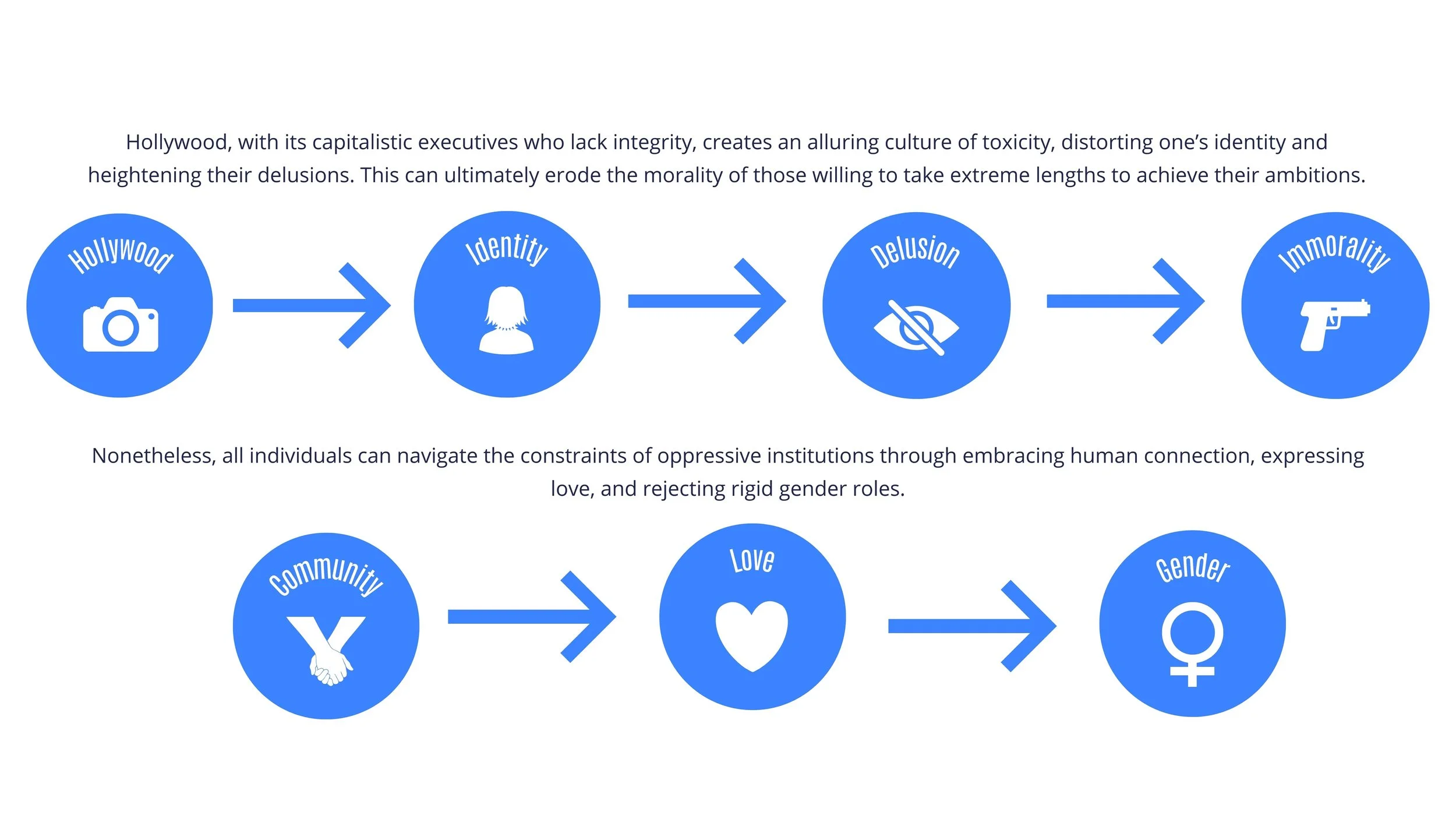
Wilder critiques Hollywood as an industry built on illusion, where creativity and individuality are valued only while they remain profitable. The system promises recognition and permanence, yet operates through disposability, discarding those who no longer serve its commercial interests. This culture fosters ambition and hope, while simultaneously cultivating insecurity, exploitation, and emotional abandonment. Hollywood appears as both a site of aspiration and betrayal, offering opportunity alongside erasure. Its disregard for human cost exposes a broader moral emptiness, revealing how fame and success are conditional, transient, and ultimately corrosive to those who mistake professional validation for personal worth.
Identity:
Wilder examines identity as fragile and contingent, shaped by external validation and societal expectation. Fame and recognition offer affirmation, yet simultaneously distort authenticity by encouraging performance over selfhood. Individuals become trapped between who they are and who they are expected to be, resulting in dislocation and internal conflict. As public image overtakes private identity, emotional stability deteriorates and self-worth becomes conditional. Wilder exposes the duality of identity as both constructed and vulnerable, revealing how dependence on external approval fractures psychological coherence and leaves individuals incapable of sustaining a grounded, autonomous sense of self.
Delusion:
Wilder explores delusion as both a psychological defence and a destructive force, arising from fear, insecurity, and unmet desire. Fantasies provide temporary comfort, preserving dignity and meaning in the face of failure or rejection. Yet sustained detachment from reality corrodes self-awareness, distorts perception, and damages relationships. As delusion deepens, it replaces accountability with denial and connection with control. Wilder exposes the duality of illusion as simultaneously sustaining and annihilating, revealing how clinging to imagined identities or futures ultimately isolates individuals, accelerates emotional decay, and ensures the collapse of both personal integrity and interpersonal trust.
Immorality:
Wilder critiques the moral erosion driven by ambition, exposing how the pursuit of success legitimises manipulation, exploitation, and ethical compromise. Characters rationalise harmful behaviour as necessary survival, blurring the boundary between pragmatism and corruption. This erosion is gradual, allowing individuals to abandon responsibility without immediate consequence. However, the long-term effects are devastating, fostering guilt, dependency, and moral emptiness. Immorality becomes both a tool and a trap: it enables advancement while entrenching cycles of control and degradation. Wilder reveals how unchecked ambition not only damages others, but ultimately consumes those who surrender their ethical agency.
Community:
Wilder presents community as a potential refuge from alienation, grounded in mutual recognition, empathy, and shared reality. In contrast to the isolating pursuit of ambition, communal bonds offer emotional stability and moral grounding. However, this warmth is fragile, easily undermined by self-interest and competition. The desire for individual advancement fractures collective support, replacing solidarity with suspicion and detachment. Community thus exists in tension with ambition: it can nurture belonging and resilience, yet is vulnerable to erosion when personal gain overrides shared responsibility. Wilder highlights how the absence of genuine community intensifies loneliness and leaves individuals exposed to exploitation.
Love & Toxicity:
Wilder presents love as an emotionally potent force capable of offering connection and purpose, while also enabling control, dependency, and self-destruction. When affection becomes possessive, it transforms into a mechanism of power that restricts autonomy and distorts reciprocity. Desire intertwines with fear of abandonment, fostering manipulation and emotional imbalance. Love’s promise of fulfilment is thus undercut by its capacity to entrap and consume. Wilder highlights this complexity, revealing how intimacy without mutual respect deteriorates into toxicity, eroding agency and accelerating psychological collapse under the guise of devotion and emotional necessity.
Gender & Power:
Wilder challenges traditional gender roles by exposing how power imbalances govern relationships and reinforce exploitation. Authority is shaped by control over resources, visibility, and validation, allowing dominance to masquerade as protection or desire. Gender expectations limit autonomy, encouraging dependency and reinforcing unequal dynamics. Yet these roles are not fixed; they are sustained through fear, ambition, and complicity. Wilder reveals that power is both enabling and corrosive, demonstrating how unequal structures distort intimacy and agency. By interrogating gendered authority, the film exposes how systemic imbalance perpetuates exploitation while disguising it as normalcy or necessity.
Narrative Elements:
Form — Feature film.
Genre — Gothic / Melodrama / Tragedy / Film Noir. Conventions/Tropes include: morally compromised protagonist, femme fatale, voiceover narration, fatalism, chiaroscuro lighting, and themes of illusion vs reality.
Setting — Los Angeles, primarily Hollywood and Sunset Boulevard, around 1949–1950, during the decline of the silent film era and the dominance of the studio system.
Focalisation — Primarily focalised through Joe Gillis.
Tense — Past (told retrospectively through Joe’s posthumous narration).
Person — First person (via Joe’s voiceover narration), combined with third-person visual storytelling typical of cinema.
Motifs:
The Engraving of Sunset Boulevard — a symbol of Hollywood, the title itself alludes to the industry's burgeoning corruption.
Pool — the pool, initially a symbol of glamour and wealth, ultimately reflects Norma’s isolation and the emptiness hidden beneath her luxurious facade.
Car — represents Joe's complete loss of autonomy; the external force limiting his ability to escape and entrapping him with Norma.
Miss Havisham — just like Miss Havisham has been left at the altar, Norma is abandoned by Hollywood, showcasing its exploitative culture.
Queen Kelly — Norma is inspired by Queen Kelly’s suicide attempt, illuminating the danger of Hollywood in blurring the line between fantasy and reality.
Norma’s Chimp — symbolic of Norma's dependency and suffocating infatuation, tainting her ability to form genuine human relationships.
Salome Script — symbolises Norma's obsession with youth and refusal to accept obsolescence.
Typewriter — the typewriter reflects Joe Gillis' creative integrity and professional autonomy, and hence its eventual neglect reflects Hollywood's desire for marketability over authenticity.
Norma's Mansion — the mansion is depicted as a mausoleum of the past, symbolising Norma's reluctance to move forward.
Photos of Norma — reinforces Norma's desire for control over self-image and refusal to let go her of who she once was.
Gold Cigarette Box — Wilder uses this object to expose the transactional nature of Hollywood relationships, where moral integrity is traded for comfort and status.
Aud Lange Syne — Aud Lange Syne, a festive song which loosely translates to “for old times’ sake,” is played at the New Year’s Eve party. The song invites listeners to reflect upon and value their relationships, which is ironic, as Joe grows to despise Norma and the parasitic chokehold she has over him.
Buttons and Bows — the parody of Buttons and Bows at Artie’s party humorously highlights the ruthlessness of Hollywood, while celebrating the energising support of community.
Prompt Bank:
‘In Sunset Boulevard, the ambition for fame and fortune propels all the characters’ actions.’ Discuss.
‘Sunset Boulevard explores the dangers of mistaking fantasy for reality.’ Discuss.
‘Sunset Boulevard is a cautionary tale against greed and deceit.’ Do you agree?
In Sunset Boulevard, how does Wilder warn of the damage that stardom can do to one’s identity?
‘Sunset Boulevard warns that love can lead to catastrophic consequences.’ Discuss.
‘Sunset Boulevard reveals the destructive nature of Hollywood’s obsession with fame and success.’ Discuss.
‘Sunset Boulevard both advocates for and condemns interpersonal relationships.’ To what extent do you agree?
How does Sunset Boulevard showcase the danger of focusing too much on appearances?
How does Sunset Boulevard offer an examination of the complexities of power dynamics in Hollywood?
“I’d started concocting a little plot of my own.” ‘The characters are morally responsible for their own downfalls.’ To what extent do you agree?
Exemplary Essay:
“Look at this street. All cardboard, all hollow, all phoney, all done with mirrors. You know, I like it better than any street in the world.”
How does Wilder convey that Hollywood is both hollow and alluring?
In surrendering completely to our delusions of grandeur, we allow the illusion of success to distance us from the harsher truth that the world does not exist to serve our interests. Billy Wilder’s 1950 motion picture ‘Sunset Boulevard,’ a work of melodramatic film noir, suggests that whilst Hollywood’s grandiosity can be enticing in its fame and recognition, ultimately the industry, with its intoxicating allure, is relentlessly callous towards vulnerable aspirants. Exposing the immorality of Hollywood’s hyper-capitalist objectives, Wilder criticises the industry’s prioritisation of financial mobility, over the amplification of genuine storytelling. Yet, whilst the tantalising American Dream offers a glimpse of hope for some, the toxicity of Hollywood can create a dysfunctional culture, transforming ambition into delusion. Thus, Wilder presents how the glamorous and decadent nature of Hollywood is simultaneously defined by its inherent cruelty and hollowness.
Wilder exposes how Hollywood, with its culture of superficiality, is driven by profit, rather than meaningful creativity. As Joe attempts to enthusiastically pitch his manuscript to Sheldrake, Wilder juxtaposes Sheldrake’s apathy as he casually relaxes and smokes a cigar against Joe’s metaphorical “hunger.” Even when Betty recognises Joe for his talent, he ardently undermines his artistic abilities, asserting that “this year [he is] trying to earn a living.” Abandoning his integrity for financial stability, Joe is used as a vehicle to express how writers are placed at the mercy of pitiless producers who value monetary gain over authentic artistry, providing a commentary on the capitalist system in 1950s America. Sheldrake’s indifference is mirrored through the revered DeMille’s rejection of Norma’s script, as he assertively commands his staff to “turn that light back where it belongs,” rendering her passion futile in the face of his financial priorities. Wilder’s medium shot of Norma being relegated to the periphery, whilst DeMille directs, visually emphasises the marginalisation of her creative ambition. By hastily dismissing Norma’s vision and asserting control over the set, DeMille epitomises the hedonistic pursuit of the self-serving film industry that shatters individual dreams to achieve commercial success. Thus, rather than being given a chance to portray Salome in film, Norma, being cast out of the entertainment industry as a caricatured representation of the Silent Era, internalises Salome’s femme fatale role, ultimately catalysing her descent into madness. Thus, depicting the film industry as utterly hollow, Wilder criticises how it relies on cultivating transactional relationships and squashing authentic storytelling as a means of maximizing the profit of executives.
However, believing in the American Dream, Wilder illuminates the possibility of achieving prosperity for individuals capable of telling stories within Hollywood, whilst recognising its shortcomings. Although Norma is unable to recognise that the glitz and glamour of Hollywood is inauthentic, Betty, serving as an antithetical foil character, accepts the “hallow [and] phoney” nature of the entertainment industry. Yet she ironically likes Hollywood “better than any street in the world,” suggesting that genuine fulfilment within a flawed system stems from an awareness of its imperfections. Thus, Wilder critiques the disingenuousness of the industry, whilst simultaneously acknowledging that dreams can be achieved for those, like Betty, who are able to transcend its superficiality. Such optimism transforms Joe’s cynicism when he commits to “finish[ing] [his story], no matter what,” reflecting his newfound sense of autonomy. Instead of coveting money and temporary security, Joe strives towards living a life of fulfillment by leveraging the liberties and opportunities that the American Dream provides. Joe’s eagerness to step out of Norma’s shadowed mansion, bathed in chiaroscuro lighting, into the bright openness of Betty’s office symbolises his moral clarity, as he briefly escapes the chains of material indulgence. By moving away from Norma’s opulence and towards Betty’s passion for the arts, Joe momentarily recognises how the Hollywood Dream is attainable, not through longing for an idealistic dream, but through exhibiting pragmatic self-awareness. Thus, even amidst a system that can deflate the “human spirit,” both characters gain an appreciation for Hollywood upon recognising they have the capacity to achieve prosperity if they navigate the industry introspectively. Thus, Wilder illuminates the duality of Hollywood as a system capable of both destroying and fuelling one’s dreams and aspirations.
Yet, when this unrelenting drive for success becomes all-consuming, the unforgiving industry can create an unstable environment for individuals to operate in. From the onset of the film, Wilder ominously foreshadows Joe’s deterioration as a character by capturing a medium shot of his corpse ironically splayed out as a star, having paid the “price” for the pool “he always wanted.” Joe’s tragic demise is captured through the “distorted and blown out” lenses of the media, symbolising how the truth is misrepresented to perpetuate a sensationalised narrative. By constructing this visual metaphor, Wilder scrutinises Joe’s indulgent tendencies — although he initially mocks the shallow nature of the film industry, he ultimately participates in it to further his own career, at the expense of his life. However, as the posthumous narrator, Joe’s “truth” may not be completely objective because he embellishes the story to present himself as the victimised “poor dope”, placing responsibility on Hollywood itself. Hence, the unreliable narration emphasises the manipulation and untrustworthiness that pervades the exploitative system. Much in the same way, Norma’s perilous journey is mirrored when she figuratively endures “an army of beauty experts” in an attempt to revitalise her image. The militaristic description of Norma’s merciless beauty regime captures the dehumanising efforts that actresses must undergo to meet the parochial demands of Hollywood, where one’s public-facing image is valued above all else. Norma desperately yearns to return to her “millions” of fans, but just like Buster Keaton and her fellow “Waxworks,” they are relegated to the sidelines and embody the life of Miss Havisham, unable to reconcile with the transition into the Talkies. In essence, when lofty ambition deludes individuals into pursuing a misguided fantasy, Hollywood’s disposable treatment only creates a false sense of security.
Thus, although Wilder’s Sunset Boulevard recognises the allure and glitzy façade of Hollywood, those who passively accept its appeal are ultimately ensnared by the system’s destructive flaws. Wilder exposes the capitalist framework of the entertainment industry, condemning the prioritisation of profit over artistic integrity. However, those who can embrace the limitations within the captivating system have a greater potential for personal growth than those who are blinded by self-interest. As such, Sunset Boulevard offers a cautionary warning and a hopeful vision of Hollywood where a balance between ambition and awareness must be found to achieve a fulfilling life.
Essay Written By Jasey Pham