Mastering Jane Harrison’s Rainbow’s End
As we have progressed as a nation, we have increasingly revised our history to highlight the experiences of First Nations Peoples — schools are exploring colonisation in the curriculum, workplaces are facilitating training sessions on Indigenous culture, and the government is implementing legislation to dismantle the structural barriers faced by Aboriginal Australians. Although we have come a long way, those experiencing intersectional oppression are still excluded from these conversations.
In light of this, Jane Harrison’s play “Rainbow’s End,” a work of social realism, tells the story of “unsung” heroic Aboriginal women who have been underrepresented in Australia’s mainstream media, as they are at the intersection of multiple marginalised identities. It’s such a powerful work of art that invites its audience to broaden their understanding of Aboriginal culture and recognise the enduring repercussions of colonisation.
For those studying the play, we have put together a blog post with everything you need to excel at your assessment, along with an exemplary 10/10 text response essay. All the best!
Plot Summary:
The play centres on three generations of Aboriginal women living together: Nan Dear, Gladys, and Dolly. Although the family resides in a crude humpy prone to flooding, Gladys, ignited by a sense of hope, tries to help Dolly find a job and learns to read using encyclopaedias sold by Errol, a young ‘whitefella.’ Meanwhile, Dolly and Errol develop a friendship. They long for a romantic relationship but are hesitant because of societal prejudice. However, their friendship is severed when Errol disrespects the Aboriginal way of life by trying to convince Dolly to move to the city. Dolly walks away from Errol, only to be assaulted by her cousin. The first act closes with another flood damaging the humpy.
In the shorter second act, the family moves to Rumbalara (meaning ‘rainbow’), a housing project developed for Indigenous residents. With the passage of time, Dolly is now heavily pregnant, and Nan Dear begins to treat her as an adult rather than a child. This is partly due to the sexual assault Nan Dear also suffered when she was around Dolly’s age, which is implied in the play. Towards the end, Gladys delivers a speech at the signing of a petition for better housing for Indigenous residents. At this event, Dolly and Errol reconcile and resume their romantic relationship.
Context:
Historical Context:
The Queen’s 1954 Tour of Australia:
The text is set in 1950s Australia, in the area of Shepparton and Mooroopna of northern Victoria. The Queen’s 1954 tour of Australia is a real historical event that occurs within the timeframe of the text. Just like in the play, in some parts of her tour, Aboriginals were actively hidden from view as they were not yet counted as part of the population.
Rumbalara Housing Project:
The Rumbalara housing project was also a real historical event of the 1950s. These houses were built on the outskirts of Mooroopna and served as a way to assimilate Indigenous Australians into Western society, as many non-Indigenous policymakers believed that Indigenous Australians could only increase their quality of life by adopting a Western way of life. Although the project was developed because of complaints of inadequate housing for Indigenous Australians, the houses were still of substandard quality and segregated from non-Indigenous communities.
The Stolen Generations:
The text is set within the period of the Stolen Generations, during which Australian Aboriginal and Torres Strait Islander children were forcibly removed from their families by government agencies and churches to assimilate them into white society.
Societal Context:
Since the 1950s, various reclamation efforts have been led by Indigenous people, such as Mabo who overturned the concept of ‘terra nullius’ in 1992. Additionally, Indigenous Australians gained the right to vote in 1962 and were officially counted in the census in 1967.
21st Century Paternalism:
However, achieving citizenship and formal legal rights did not automatically result in social equality. Non-Indigenous policymakers have continued to exert control over Indigenous communities, limiting their agency and self-determination. For example, the Northern Territory Intervention in 2007 was introduced to improve living conditions in remote Indigenous communities through measures such as strict alcohol regulations and welfare controls. Although framed as protective, the policy was widely criticised as paternalistic, as it imposed sweeping changes without adequate consultation, reinforcing inequality rather than empowering Indigenous Australians.
Voice to Parliament:
The 2023 Voice to Parliament failed to pass its referendum. The Voice was proposed to be a federal body of Indigenous Australians with the role of advising the government on matters affecting them and their communities.
Treaty:
Today, Australia is one of the only Commonwealth nations that still lacks a formal treaty with its Indigenous peoples. A treaty is a legally-binding agreement between two or more parties that must be signed by all sides.
Authorial Context:
Jane Harrison:
Jane Harrison is an Indigenous Australian woman of Muruwari descent, originally from the Bourke and Brewarrina region, who grew up in Dandenong, Victoria. From a young age, Harrison was aware that she and her mother were of Indigenous heritage; however, she lacked a strong, authentic connection to a specific Aboriginal community. Playwriting has therefore become a means through which she seeks to rediscover and nurture a connection to her people and their stories. Harrison describes her plays as a “conduit” for authentic Indigenous narratives that are often overlooked or marginalised within Australia’s mainstream media. She feels a deep responsibility to represent these stories truthfully from an Aboriginal perspective, giving voice to those who have been silenced across generations. This commitment stems from her belief that colonisation remains an unresolved issue within contemporary Australian society, one that is metaphorically carried within all of us. Such a perspective reflects the traditional Indigenous understanding of time as non-linear, where the past, present, and future coexist and can be accessed simultaneously through connection to Country.
Rainbow’s End was commissioned by Ilbijerri, Melbourne’s only Aboriginal and Torres Strait Islander theatre company, which sought a production centred on the “heroes” of a decade of Victorian Koori history. Rather than focusing on prominent public figures, Harrison chose to craft a fictional account highlighting the Indigenous women working “behind the scenes,” thereby illuminating these often-overlooked contributors. In the play, these women sustain their families and navigate daily hardships while the men — represented by the fictional Papa Dear — engage in more visible forms of advocacy within the broader society.
Authorial Intent:
Segregation & Assimilation:
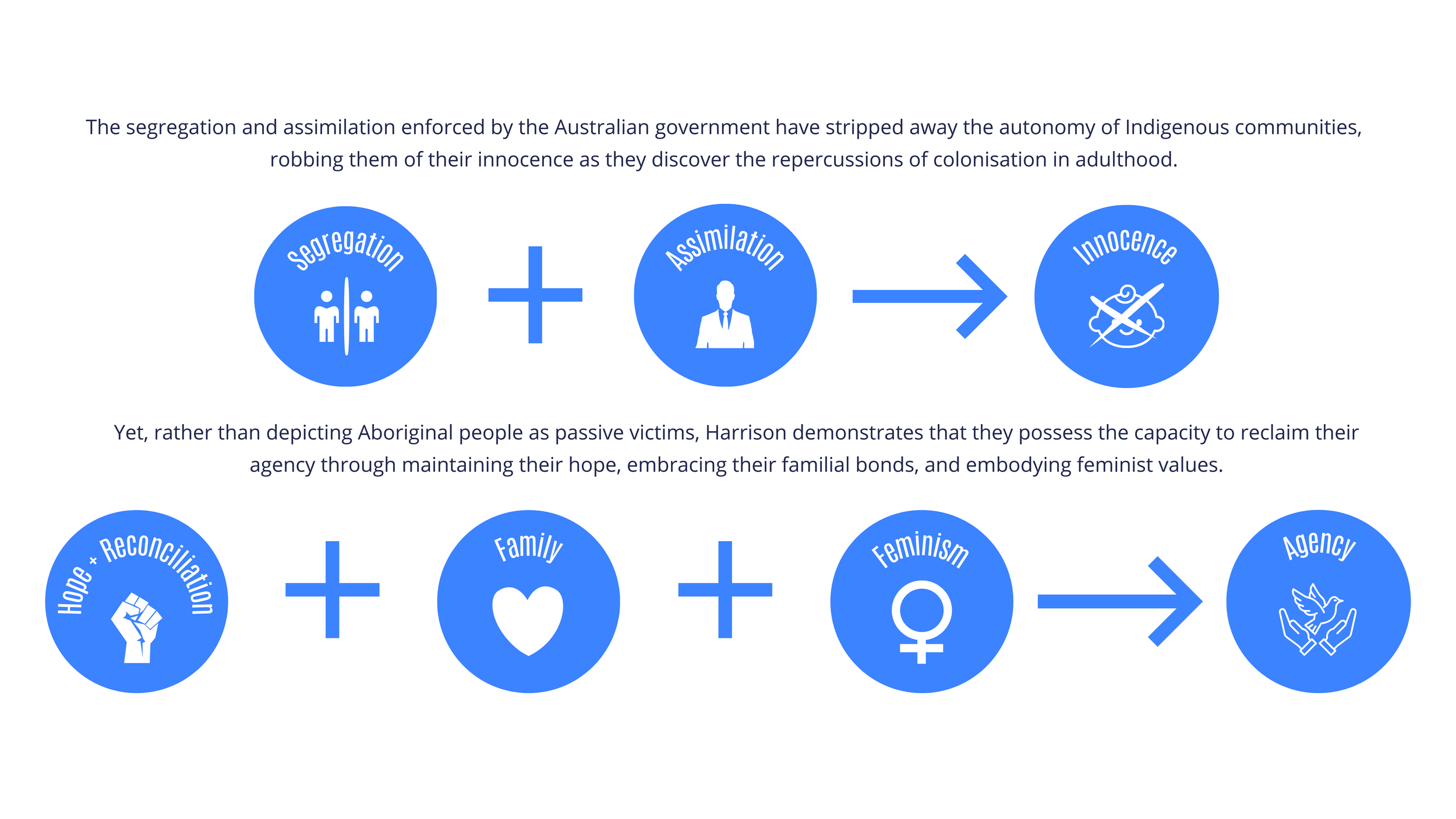
Harrison condemns segregation as a policy that enforces physical and psychological division, institutionalising inferiority while masquerading as protection. It spatially isolates Indigenous communities, reinforcing the notion that cultural difference warrants exclusion and surveillance. At the same time, Harrison critiques assimilation for demanding cultural erasure under the guise of equality, insisting that acceptance is conditional upon conformity to white Australian norms. Where segregation excludes, assimilation absorbs — yet both function to invalidate Indigenous identity.
Hope & Reconciliation:
Harrison presents hope as a contested force: frequently dismissed as naïve within oppressive systems that profit from cynicism and stagnation. In communities conditioned to expect disappointment, hope can appear dangerous, even foolish. Yet the playwright reframes it as radical — the emotional precursor to action and the psychological refusal to accept injustice as permanent. Reconciliation, in turn, is depicted not as a symbolic gesture or governmental slogan, but as a demanding moral process requiring truth, accountability and structural change.
Agency:
Harrison interrogates the fragility of agency within a society structured to deny Indigenous autonomy, exposing how systemic prejudice, government control and economic marginalisation constrain choice while maintaining the illusion of opportunity. Yet she refuses to frame Aboriginal characters as passive victims of circumstance. Instead, Harrison demonstrates that agency, though compromised, is never entirely extinguished; it can be reclaimed through defiance, solidarity and the refusal to internalise imposed limitations.
Family:
Harrison elevates Indigenous family structures as resilient sites of continuity in a society intent on fracture. Intergenerational bonds become acts of cultural preservation, where storytelling, reciprocity and shared responsibility sustain identity despite external pressures to dismantle it. Yet she does not romanticise hardship; these families operate under constant threat — of poverty, removal, and social scrutiny. The strength of kinship networks emerges not from idealism but from necessity. In foregrounding this dynamic, Harrison suggests that while colonial systems attempt to weaken Aboriginal communities by targeting family cohesion, it is precisely this interconnectedness that enables endurance and resistance.
Innocence & Coming-of-Age:
Harrison portrays innocence not as ignorance, but as moral clarity uncorrupted by inherited prejudice. In a society where racism is normalised and transmitted across generations, innocence possesses quiet subversive power: it questions assumptions adults accept without scrutiny. Yet this state is precarious. Coming of age involves an inevitable confrontation with systemic injustice, forcing young characters to reconcile idealism with lived reality. Maturity, in this context, is not simply growth but awakening — an often painful recognition of inequality.
Feminism:
Harrison demonstrates the intersectional oppression faced by Indigenous women — beyond experiencing racial discrimination, they are forced to conform to rigid societal expectations and fulfil the role of submissive housewives, further stripping away their agency. Interestingly, in Aboriginal culture, gender roles are not hierarchical, but complementary — both men and women hold power in their respective domains; thus, by rejecting Australia's Eurocentric patriarchy, Aboriginal women have the ability to reassert their authority as women, while simultaneously rebelling against colonisation and reconnecting with their cultural roots.
Narrative Elements:
Form — Stage play.
Genre — Historical drama / Social realism. Conventions and features include: naturalistic, detailed sets, relatable characters struggling against their environment, mundane dialogue, and a critical, political examination of society.
Setting — The 1950s in the northern Victorian area of Shepparton and Mooroopna.
Focalisation — Focalised through the perspectives of three Indigenous women — Dolly, Gladys and Nan Dear.
Tense — Present tense.
Person — Third person (dramatic form).
Motifs:
Que Sera, Sera — the song, translating to “whatever will be, will be,” demonstrates the importance of accepting the unavoidable obstacles of life in adulthood.
Encyclopedias — the encyclopedias, being expensive and easily destroyed, represent the rarity and fragility of Western education for Indigenous communities.
Dream Scenes — the dream sequences represent hope, whilst simultaneously symbolising naivety as they romanticise and erase the barriers faced by Aboriginal Australians.
Voiceover — Aboriginal people’s voices are increasingly featured on the voiceover, symbolising the reclamation of their agency.
Repetition of Flood — both acts open with a flood that destroys the family’s home. Water therefore represents how Indigenous communities are unjustly disadvantaged due to colonisation.
The Fringe Settlement — by situating Indigenous families on the literal outskirts of town, Harrison accentuates how colonial society pushes Aboriginal identity to the edge of national belonging.
Government Inspectors — the arrival of inspectors symbolises the government’s institutionalisation of oppression.
The title "Rainbow's End" — the title itself operates as an ironic symbol. While a rainbow traditionally signifies hope and promise, its "end" implies something distant and unreachable; like a pot of gold.
Prompt Bank:
‘In Rainbow’s End, the characters have little control over their lives.’ Discuss.
‘Rainbow’s End emphasises the importance of familial bonds during times of hardship.’ Do you agree?
‘Rainbow’s End praises those who maintain optimism in the face of hardship.’ To what extent do you agree?
“Why do we have to prove we can live like whitefellas, before we get the same opportunities?”
How does Rainbow’s End explore injustice?
How does Rainbow’s End highlight the importance of home and belonging?
‘In Rainbow’s End, the characters are torn between white Australia and their Indigenous heritage.’ Do you agree?
‘Rainbow’s End demonstrates that trauma is intergenerational and impossible to overcome.’ Discuss.
How does Rainbow’s End commend those who exercise their agency in the face of discrimination?
‘In Rainbow’s End, hope is depicted as naïve and impractical.’ Do you agree?
“Nan, I’m nearly seventeen. You can’t scare me with ‘boogey man’ stories anymore.”
‘In Rainbow’s End, maturity inevitably results in suffering.’ To what extent do you agree?
Exemplary Essay:
‘Rainbow’s End showcases the importance of optimism in the face of hardship.’ Discuss.
Is optimism a powerful tool for reclaiming one's agency in an oppressive society or an idealistic coping mechanism? Exploring this tension, Jane Harrison’s 2005 coming-of-age play Rainbow’s End follows the lives of three Aboriginal women as they navigate racial segregation and systemic injustice in 1950s Australia. While cynical individuals may perceive hope as naïve and unrealistic, Harrison is firm, in her belief, that marginalised communities can tackle oppression by adopting a positive outlook on life. Despite this, Jackson acknowledges that optimism is insufficient at achieving justice; only individuals who resist the status quo can address the structural inequalities entrenched within Australian society.
Harrison recognises that hopeful individuals are often dismissed as idealistic and impractical by those aware of the pervasiveness and severity of human cruelty. After learning about Rumbalara, Gladys imagines a "tap" flowing with "blue jewels" in a dream sequence, illustrating how she is faithful that her family will achieve prosperity through time. In Aboriginal artwork, the colour blue typically represents two fundamental elements of the natural world — water and sky. Therefore, by utilising the colour, Harrison demonstrates Gladys' optimistic belief that Rumbalara, apart from improving her family's access to resources, will repair their spiritual connection to Country. In contrast, Nan Dear, serving as a foil character, "bring[s] the fantasy to an end," represented through the "lights chang[ing] back to reality." In the theatre, stage lighting is an unnaturalistic device that shapes the emotional landscape of the characters by relying on the audience suspending their disbelief. However, unlike the audience, Nan Dear refuses to set aside her doubts and fuel her daughter's delusions, as she is cognizant that the Australian government has historically stripped away the agency of Indigenous communities whenever they have paternalistically intervened. Thus, while Gladys celebrates that Rumbalara translates to "rainbow's end," Nan Dear pessimistically reminds the audience that the housing is being built in "Daish" — the "town tip." Interestingly, the legend that rainbows end with a pot of gold originates from Irish folklore; a genre, featuring supernatural, fantastical tropes, that is not grounded in reality. Hence, Nan Dear's scepticism is ultimately affirmed by Harrison, as optimism can be defined as a romanticised coping mechanism that ignores the injustice embedded within Australia's post-colonial society.
Yet despite this, Harrison is acutely aware that family bonds foster hope and resilience for Indigenous communities, assisting marginalised communities in reclaiming their agency. Nan Dear is the antithesis of Dolly — she cynically villainises all white Australians and dismisses optimism as naïve. Yet during the falling action, they "hold each other" while they openly share their trauma, as human beings are inextricably linked with their family both emotionally and spiritually. This is particularly true for Aboriginal communities, who believe that all family members—not just biological parents—are responsible for raising young children. As a result of their sacred connection, Nan Dear, an inherently pessimistic character, "laughs" for the very first time in the play, indicating how Dolly has ignited a sense of hope within her. Perhaps she is not convinced that Aboriginal people can break free from the chains of post-colonialism, but she is confident that her family motivates her to persist in the face of adversity. In contrast, Gladys, although committed to Aboriginal justice, initially relies on others to advocate on her behalf. However, upon looking at Dolly, "something snaps," motivating her to fight for her family in a "determined fashion" at the Rodney Shire Council meeting, where she passionately asserts, "I’m not an interloper—I belong here—this is my land!" Here, Harrison's confrontational tone, coupled with her use of an exclamation mark, accentuates Gladys' defiance — she is not only breaking the "rules" of the council meeting, but metaphorically rejecting the societal expectations that European settlers expect her to fulfil as an Aboriginal woman. In this regard, Gladys' love for Dolly creates a sense of hope, driving her to challenge systemic injustice and demand change. Thus, optimism, when fuelled by familial bonds, can empower minorities to resist oppression.
However, Harrison highlights the limitations of optimism, suggesting that defying societal norms is necessary to achieving justice. In the final scene, Gladys "marches up to the podium" to deliver a powerful monologue, with rhetoric and a punchy rhythm, mirroring the speeches presented during the civil rights movement. In particular, she speaks directly to "Queen Elizabeth the Second" — a physical representation of colonisation itself — demonstrating that Aboriginal people, apart from maintaining their optimism, need to legitimise, adhere to, and operate within European social constructs in order to achieve positive reform. Rather than merely campaigning for Aboriginal justice, Gladys advocates for a world in which women are empowered to dictate their own destiny. As Gladys questions Papa Dear's use of the word "humbly," she is symbolically critiquing the script that women are expected to follow. Interestingly, in Aboriginal culture, gender roles are not hierarchical, but complementary — both men and women hold power in their respective domains; thus, by rejecting Australia's Eurocentric patriarchy, Gladys is simultaneously rebelling against imperialism and reconnecting with her cultural roots. Gladys' self-sufficiency is reflected through Harrison's depiction of Papa Dear as a mysterious off-stage figure, further illuminating how she is conforming to Aboriginal ideals of femininity, as she is exercising agency without relying on male authority. The overlap of feminism and cultural reclamation is perfectly encapsulated through Harrison's overall intent; to write a play about "unsung heroes" facing intersectional oppression, whose stories have been underrepresented in Australia's mainstream media landscape.
At its core, Rainbow's End is an exploration of the importance of optimism in empowering minorities to reclaim their power. Although hopeful individuals may overlook the prevalence of racism in post-colonial societies, they have the capacity to achieve social justice, particularly if they pair their positive outlook on life with an eagerness to defy the social norms that are oppressing them. Hence, Harrison invites her 21st century Australian audience to recognise the power of maintaining their faith in the midst of hardship — it is not a naïve coping mechanism, but a lethal weapon for tackling the prejudice and injustice deeply rooted in society.