Mastering Trevor Noah’s Born a Crime
Even though the western world has historically misrepresented, minimised, and dismissed injustices they have perpetuated, institutions are becoming increasingly aware of the damage they have caused, particularly in regards to British imperialism and the transatlantic slave trade.
However, very little attention has been payed to apartheid, a series of racial segregation polices in South Africa that subjugated the black community. Even though it was one of the most destructive systems of racial oppression, most westerners have very limited knowledge—if any—around apartheid and its long-lasting effects.
This is precisely why Born a Crime exists — to educate a western audience about apartheid, exposing the enduring legacy of racial oppression that continues to shape South African society. Consistently throughout his memoir, Noah makes references to American culture and uses analogies that US readers will understand to help them digest the realities of living in South Africa in the 20th century.
Born a Crime is one of the most enjoyable books on the VCE text list. It’s incredibly funny, yet profoundly insightful, giving you lots of opportunities to develop interesting and perceptive points of analysis. Anyway, enough from me. Let’s jump straight into it!
Context:
Historical Context:
Apartheid Era:
During Noah’s childhood, South Africa was under Apartheid, a policy of racial segregation that governed interactions between white and non-white South Africans. Meaning ‘Apartness’ in Afrikaans, Apartheid was designed to strip away the rights of black people by dictating where they could live, work and even whom they could marry.
During Apartheid, land and property were stripped away from black people, forcing them to live in specially designed areas called Townships, which were underdeveloped, over-populated and devoid of basic amenities. In ‘Born a Crime’ Noah describes growing in one of these townships, called Soweto.
In response to pressure from violent protests, international sanctions, and activists such as Nelson Mandela, Apartheid was abolished in the early 1990s.
Immorality Act of 1927:
One of the policies that Noah references in ‘Born a Crime’ is the Immorality Act of 1927, which prohibited white men from having sexual relations with black women. As such, Trevor’s entire existence is considered a crime, given his mother is Xhosa and father is European.
Post Apartheid Era:
After Apartheid ended, many assumed that South Africa would transform into a ‘Rainbow Nation at peace with itself and the world’ (Mandela, 1994). However, the abolition of Apartheid’s policies did not automatically resolve the deep-rooted inequalities ingrained in society. With high crime rates, violence, and social unrest, the country was still very much divided. In ‘Born a Crime,’ Noah calls this period the ‘Bloodless Revolution’ as ‘very little white blood was spilled,’ but ‘black blood ran in the streets’.
The economic policies of Apartheid have created an unequal distribution of wealth, with a significant portion of the population struggling to access basic amenities, services and opportunities. In ‘Born a Crime’ Patricia calls this the ‘black tax,’ as non-white people are cursed with having to spend all their time fixing the problems of the past before they are able to create their own legacy.
Authorial Context:
Trevor Noah:
Trevor Noah is a South African comedian, philanthropist and writer who is best known for his role as the host of Comedy Central’s ‘The Daily Show,’ an American late-night talk show and satirical news program. He was born in Johannesburg, South Africa in 1984, several years before the end of Apartheid in the early 1990s.
Noah considers himself as a progressive person who has a global perspective. He has been vocal about supporting women’s equality, education, and social justice. More recently, Noah has established a charity called the Trevor Noah Foundation which funds opportunities for South African youth.
In light of the prejudice Noah has experienced, he is passionate about using his platform to speak out on discrimination, racism, and the need for systemic reform. However, given he is a comedian, he does not dwell on the negatives, but rather celebrates those who are able to remain hopeful through embracing their relationships, strengthening their resilience and, perhaps most importantly, recognising the power of having a laugh.
Authorial Intent:
Apartheid & Racism:
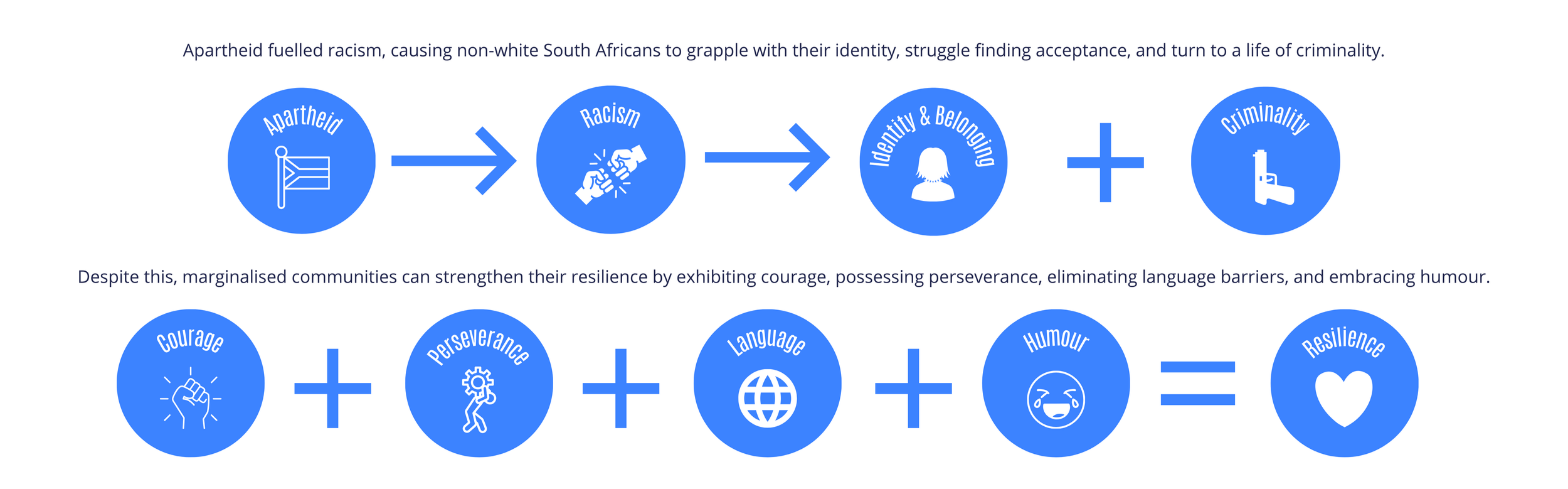
Noah exposes apartheid and racism as deeply entrenched systems designed to divide, dehumanise, and control South African society. Through both legal restrictions and everyday social interactions, racism dictates where individuals may live, whom they may love, and how they are perceived. Trevor’s very existence as a mixed-race child is criminalised under apartheid law, illustrating the absurdity and cruelty of a system that defines humanity through race. Even after apartheid’s formal end, Noah demonstrates that racism persists in social attitudes and power structures, revealing its lasting and corrosive impact on identity, opportunity, and belonging.
Identity & Belonging
Noah illustrates how finding acceptance is particularly difficult for mixed-race individuals, as their place within society is often ambiguous. For Trevor, white people reject his Xhosa heritage, while black people resent his European ancestry, trapping him in a liminal, in-between space. In fact, among many mixed-race individuals, belonging remains elusive, as each possesses a distinct family lineage and there is no single, unified culture to anchor their identity.
Resilience:
Although apartheid seeks to dehumanise and limit those it oppresses, Noah demonstrates that resilience allows individuals to endure and rise above systemic injustice. While suffering and hardship are unavoidable, resilience transforms adversity into a source of strength rather than misery. One can transform their mentality through embracing their sense of humour, forging connections, and turning to faith.
Courage & Perseverance:
Although many aspects of life are scary, regret is what we should fear the most. While failure can be damaging, at least it provides closure; regret, on the other hand, is an eternal question that we will never have the answer to. Thus, exhibiting bravery is integral to living a life of fulfilment, as it allows us to live without regret. Similarly, determination is key to overcoming adversity — it empowers minorities to reclaim their power, resist oppression, and forge identities in a society designed to exclude them.
Power of Humour:
As a comedian, Noah is firm, in his belief, that humour is the most powerful tool for overcoming the difficulties of life, particularly in unjust societies. It allows individuals to reframe their mindset, transforming painful experiences into joyful ones. Apart from fostering resilience, humour has the capacity to assist outsiders in forging connections and finding a sense of belonging.
Power of Language:
Noah amplifies the power of language in fostering human connection, allowing minorities to find acceptance in oppressive societies. He believes that learning a shared language with our community highlights our similarities, disputing the racist, white supremacist belief that racial segregation is natural and inevitable. In a similar vein, the existence of language barriers further separates individuals along racial lines, maintaining a culture of division and exclusivity. English, in particular, creates opportunities for black people to enter the workforce and tackle cyclical poverty.
Criminality & Immorality:
Due to apartheid, black South Africans have been denied opportunities to accumulate wealth, creating a relentless cycle of inequality, as poverty is passed down through generations. This has forced black communities to commit crimes, not because they are inherently immoral, but because they are attempting to break free from the chains of poverty. Noah therefore depicts crime as an opportunity for marginalised communities, driving his western audience to empathise with individuals who break the law out of necessity. Yet simultaneously, Noah recognises that committing transgressions can bring about psychological pain within those affected, demonstrating the duality of criminality.
Narrative Elements:
Form — Non-fiction.
Genre — Memoir. Conventions and features include: first-person narration, real-life experiences, and an exploration of identity, relationships, and self-discovery.
Setting — South Africa during and after the apartheid era.
Focalisation — Focalised through the perspective of Trevor Noah, a mixed-race South African.
Tense — Present tense.
Person — First person.
Motifs:
Trevor’s Birth — Trevor’s birth violated the Immorality Act, illustrating the irrationality of apartheid and the criminal justice system.
Patricia’s Second-hand Volkswagen — Trevor attributes many of the difficulties he faces to Patricia’s bright-tangerine Volkswagen Beetle, thus rendering it a symbol for the unavoidable obstacles of life.
Stolen Digital Camera — When Trevor notices photos of a family in his stolen camera, he is able to recognise the consequences of his unlawful behaviour, allowing him to perceive criminality as harmful, despite its benefits to black communities facing poverty.
Food — as a child, Trevor’s food is sparse and bland; a physical manifestation of his poverty.
Mulberry Tree — Trevor is assaulted at the Mulberry Tree for appearing too black. It therefore serves as a symbol for prejudice.
Driveways in Soweto — serving as a symbol for hope, driveways are built by the citizens of Soweto, even though they are unable to afford vehicles.
Fake Adidas Shoes — Patricia reframes the extra stripe on Trevor’s Adidas shoes from a sign that they are a knock off, to a stroke of luck. His shoes therefore symbolise resilience.
Weather — Rather than highlighting his pain during traumatic experiences, Trevor draws attention to the beautiful weather, representing the possibility for hope.
Maylene — Maylene dumps Trevor for a popular white boy, representing South Africa’s perception of white people as superior.
Zaheera — Trevor’s does not exhibit the courage to ask Zaheera out, rendering their relationship a symbol for regret.
Babiki — Trevor is unable to truly connect with Babiki due to a language barrier, showcasing the power of language in fostering human connection.
Maryvale College — Maryvale College—a racially integrated Catholic school—is a microcosm for an idealistic, decolonised South African society.
H. A. Jack Primary School — H. A. Jack Primary School—a racially segregated elementary school—is a microcosm for the reality of South Africa following the abolition of Apartheid.
Western References — Noah makes western references throughout his memoir to create a sense of relatability, allowing his primarily American audience base to resonate with his experiences.
Prompt Bank:
‘Born a Crime suggests that non-white South Africans are still marginalised due to the legacy of the Apartheid era.’ To what extent do you agree?
In Born a Crime, the characters succeed in life because of their tenacity.’ Discuss.
To what extent does Born a Crime show the importance of survival?
“Some might say we lived like poor people. I prefer ‘open plan’.” ‘Born a Crime is a story of transformation.’ To what extent do you agree?
‘The women in Born a Crime are more powerful than the men.’ Discuss.
How does Born a Crime explore the difficulties of upholding one’s moral judgement in a country that is built upon the foundation of injustice?
“The highest rung of what’s possible is far beyond the world you can see.” ‘Born a Crime suggests that a person’s mind is their only limitation’ Discuss.
‘Born a Crime shows that language can both help and complicate a person’s life.’ Do you agree?
How does Trevor Noah use humour in Born a Crime to amplify the power of resilience?
“We spend so much time being afraid of failure, afraid of rejection. But regret is the thing we should fear most.” ‘Born a Crime suggests that facing our fears is essential for personal growth.’ Do you agree?
Exemplary Essay:
“... language, even more than color, defines who you are to people.” To what extent does Trevor Noah demonstrate this to be true?
Trevor Noah's 2016 memoir recounts the difficulties he faced as a child finding acceptance during and following the abolition of Apartheid, one of the most advanced systems of racial oppression known to man. According to Noah, one of the most sinister aspects of Apartheid was its ability to pit racial groups against each other. Although this stifled relationships between white and black communities, the elimination of language barriers can cause all human connection to flourish, proving that language, even more than colour, defines who we are to people. This, in turn, discredits the white supremacist belief that racial segregation is natural, ultimately highlighting the absurdity of Apartheid.
Noah depicts Apartheid as an oppressive system that fuels racism, prohibiting interracial relationships from flourishing. From the outset, Noah includes an image of a bill implemented by the architects of Apartheid "to prohibit illicit carnal intercourse between Europeans and natives." By labelling this legislation as the "Immorality Act," the nationalist government is conditioning South African people to view interracial relationships as not only illegal, but unethical, driving them to view racial segregation as righteous and just. This has led to widespread racism, as exemplified through Noah's experience at the Mulberry tree, in which a group of children label him a "bushman." This is a highly offensive racial slur—historically directed towards Indigenous South Africans—that implies black people are primitive and uncivilised. As such, the young people's abuse cannot be attributed to their immaturity, but their prejudice towards black folk, which has deterred them from forming interracial relationships. This is physically represented through the segregation at Maryvale College, where the "white kids… went in one direction" and the "black kids went in another direction," leaving Noah "totally confused." The students have internalised the belief that friendships can only be formed within the limits of racial boundaries, thus rendering Maryvale College a microcosm for South African society. Hence, due to systems established to spread white supremacy, colour has historically defined who we are to people.
Yet Noah suggests that the elimination of language barriers strengthens all relationships, even the ones that cross racial lines. Noah speaks several languages: German to form a better relationship with his father, Xhosa to understand the language of his people, and English to interpret ‘what the white man is saying’. As a result, he is able to assimilate into black friendship groups by ‘speaking African languages' and the culture in prison by ‘speaking in broken Afrikaans with a thick coloured accent’. Commenting on his ability to fit in so effortlessly, Noah metaphorically labels himself as a ‘chameleon’ to provide a physical manifestation of his adaptable nature. This is perhaps most clearly illustrated when he avoids being mugged by a group of Zulu men by speaking their language in an attempt to convince them they are 'part of the same tribe.’ Here, the use of the noun "tribe" carries positive connotations of loyalty and belonging, implying that speaking a shared language is not merely convenient — it's a symbolic act that builds trust, fosters connection, and bridges cultural divides. This notion is bolstered by Noah’s own use of language in ‘Born a Crime,’ where he adopts a relatable style and colloquial register through referencing American brands like ‘Starbucks’ and icons in pop culture like ‘Beyonce’ to create a sense of relatability, positioning readers to feel connected with his story. Noah’s relatable voice is therefore emblematic of the power of language – just like language allows him to form relationships in his life, it is simultaneously allowing him to connect with his audience. Noah is thus firm, in his belief, that language truly does define who we are to people.
Since language determines our relationships, it therefore influences our receptiveness to diverse cultures, amplifying the absurdity of racial segregation. According to Noah, if a "brilliant scientist" from Mexico speaks in "broken English," a racist will automatically think to themselves, "eh, I don't trust this guy." In this regard, their prejudice does not stem from skin colour, but their inability to communicate effectively. Comparatively, if a Mexican scientist speaks English, "your brain short-circuits because your racism program has none of those instructions in the code." Here, Noah metaphorically likens language to code that is incompatible with a computer's programming software, suggesting that it dismantles the logic behind racism. This complex idea is deliberately simplified in an analogy delivered in the second-person, so it's more digestible for Noah's audience, further allowing him to metalinguistically illustrate how his own use of language is enhancing the effectiveness of his communication, driving his readers to form a parasocial relationship with him. The power of language in facilitating interracial relationships is perfectly encapsulated through Noah's vivid description of Johannesburg as a 'cosmopolitan' city, implying that the citizen's have a global perspective and an open mindedness to foreign languages. This has created a liberal, multi-cultural atmosphere, with 'foreign-owned' nightclubs that serve a 'mixed clientele' — 'black people who hate the status quo' and 'white people who [view Apartheid as] ridiculous.' By juxtaposing the inclusivity of Johannesburg against the prejudice entrenched in South Africa, Noah proves that the removal of language barriers renders white people more receptive to cultural diversity, disputing the idea that racial segregation is natural or inevitable.
In summary, even though skin colour can define who we are to people, Noah reveals that eradicating language barriers allows human connection to thrive, thereby discrediting the white supremacist myth that racial segregation is unavoidable. Through this, Noah invites his primarily western audience base to recognise that language is the most powerful force for dismantling prejudice. It fosters connection, creating a society where inclusivity overshadows division.