Mastering Yōko Ogawa’s The Memory Police
Do our memories make up who we are? If so, what if an authoritarian government systematically erased your memories? Would you lose your individuality? What about your capacity to fight against injustice?
Throughout the twentieth century, authoritarian regimes consolidated their power by controlling their people’s collective memory. In Nazi Germany, thousands of books were publicly burned to erase ideas that challenged the regime's ideology. In Stalin's Soviet Union, political figures who fell out of favour were removed from official photographs as though they had never existed. Time and time again, dictatorships have carefully constructed narratives to erase inconvenient truths, making it increasingly difficult for citizens to question authority and resist oppression.
Drawing upon this history, Yōko Ogawa’s The Memory Police presents a world in which ordinary objects mysteriously vanish from an unnamed island first physically, then from memory, culture, and language itself. As each disappearance is ruthlessly enforced by the Memory Police, the island's inhabitants gradually lose their capacity to remember, question, and ultimately resist.
Today, we have unpacked The Memory Police comprehensively — it’s context, narrative elements, motifs and, most importantly, authorial intent. Without further ado, let’s jump into it!
Context:
Historical Context:
World War II:
Japan’s history has been subjected to widespread criticism amidst conversations of their role in World War II. In December of 1937, Japanese forces seized the then capital of China, Nanjing. This led to the mass killing of Chinese people known as the ‘Nanjing Massacre’ or ‘Rape of Nanjing.’ The number of Chinese people killed ranges from 100,000 to more than 300,000 people. To this day, there is still no prospect of reconciliation between China and Japan.
Just a few years prior to this, in 1933, Adolf Hitler and the Nazi Party rose to power in Germany. Over their period of control, their views on Jews became increasingly radical, culminating in the Holocaust - the systematic, state-sponsored persecution and murder of six million Jewish people. In addition to this, the Nazis implemented a series of oppressive laws, including the Nuremberg Laws of 1935, which stripped Jews of their civil rights and laid the groundwork for the government’s anti-Semitic propaganda, which fuelled widespread hatred and violence against Jewish communities.
The violence and control of both the Nazis and Japanese people during WW2 are reflected in Ogawa’s novel through the brutality of the Memory Police. Just as the Axis Powers sought to erase an entire existence and identity of people, the Memory Police seek to do the same for those that can remember their memories, leaving communities powerless and unable to oppose them.
Legacy of World War II:
The Memory Police was published in 1994, almost 50 years after the end of World War II. At this time, residents of Japan were just becoming aware of the atrocities committed by their ancestors, some even finding out for the first time. This is because, previously, the events that painted Japan in a negative light were not being taught in their history classes and they reduced their own responsibility in the war by blaming Japan’s brutality on the government and military of that period. This is possibly why Ogawa has such a fascination with storytelling — it can preserve the truth and challenge the narratives that have been conveniently forgotten or distorted over time.
Buddhism:
A common belief in Buddhism is that people die twice: first physically and then again when they are forgotten by those who are still alive. This is why many Japanese people believe in keeping ties with those who have passed so that they can be protected and positively influenced by their ancestors. In particular, Ogawa believes that the past 25 years have shown her the vulnerability of the everyday world, leading her to believe that death does not mean a breaking off of ties with loved ones.
Translation:
The novel was translated into English in 2019 by Stephen Snyder, changing the name from ‘密や かな結晶’ meaning ‘secret crystallisation’ to ‘The Memory Police’. Ogawa’s Japanese title paints the picture of memories slowly fading away and a person’s heart growing cold and distant. This is important to consider as it emphasises that, at its core, the novel is not about the savagery of totalitarian governments, but rather the fragility of life and the interconnectedness between loss and identity.
Authorial Context:
Yōko Ogawa:
Yōko Ogawa has always had a keen interest in Anne Frank’s life. After reading her novel ‘The Diary of a Young Girl’ as a young teenager, she developed a love for writing because it could ‘give people freedom’ (Rich, 2019). Interestingly, just like Frank, who escapes the persecution of the Nazis in WW2, R hides to escape the Memory Police in Ogawa’s novel. Here, it is evident that Ogawa is mirroring Frank’s life and paying homage to her diary. Beyond this, the items and experiences that were stolen from Frank during her lifetime served as inspiration for the disappearances on the island in Ogawa’s text (Nippon, 2020).
In a recent interview, Ogawa described her belief that, as a writer, she was just a medium for transferring stories from the outside world. She was inspired by fellow author Paul Auster, who felt like he was writing down stories someone told him, rather than creating them himself (Nippon, 2020). In addition to this, Ogawa has a particular interest in memory, given she has written a number of novels that revolve around this theme. Her most popular novel ‘The Professor and the Housekeeper’ tells the story of a mathematician that cannot remember anything new for more than eighty minutes.
In addition to this, Ogawa is adamant that ‘The Memory Police’ is not a political allegory. Whilst the novel is set against the backdrop of an island controlled by a totalitarian government, she does not focus on their actions, but rather draws attention to the ways in which people respond in the face of authority.
Authorial Intent:
Totalitarianism:
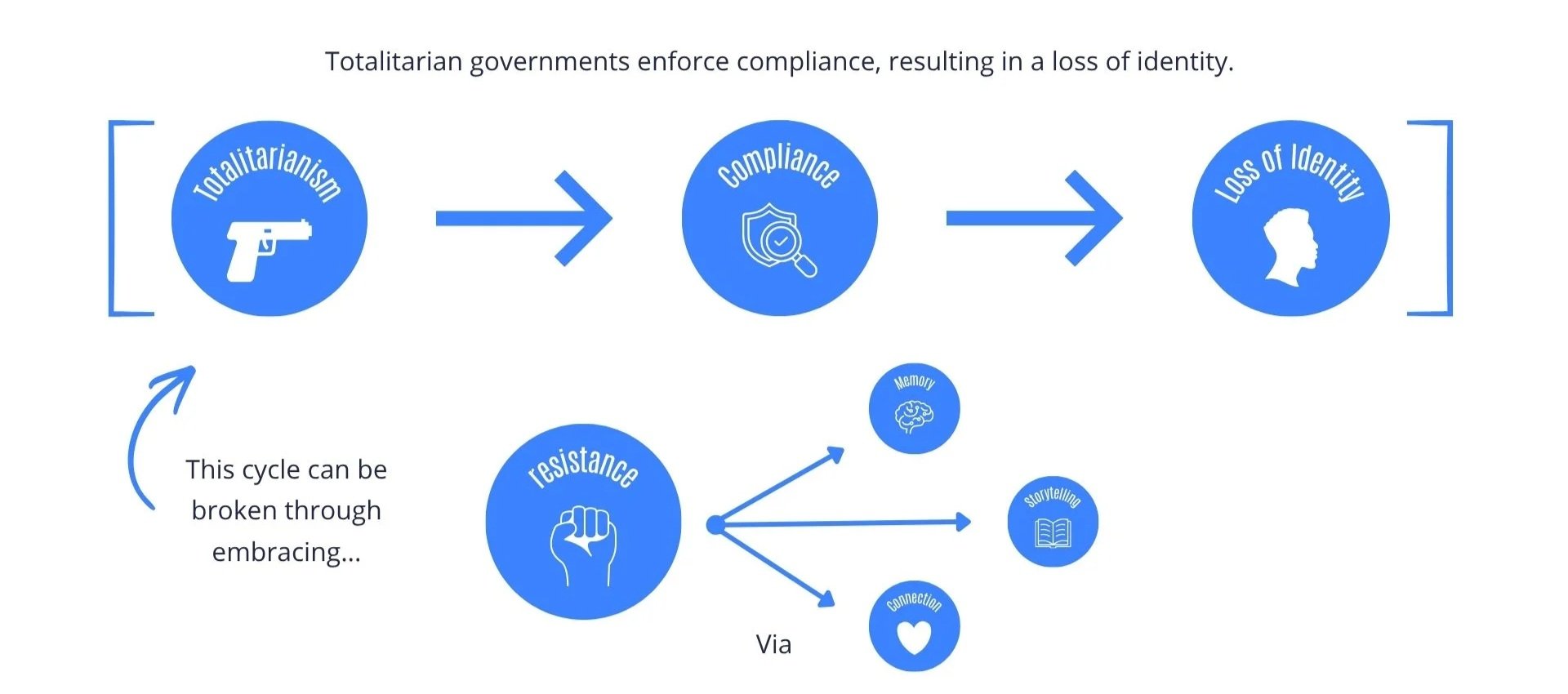
Ogawa exposes the unethical measures authoritarian governments are willing to take in order to establish and maintain their power, including surveillance, forensic DNA analysis, and psychological manipulation. They prevent their citizens from protesting by systemically normalising brutality, eliminating human connection, and creating a culture of fear, silence, and moral apathy, forcing the community to become obedient enablers of cruelty. This exacerbates the regime’s authority, prompting government officials to squash core components of the citizen’s identities, so they’re erased from memory altogether.
Loss & Identity:
Ogawa highlights how loss triggers a chain reaction, culminating in the erosion of identity. When human beings lose their autonomy in dictatorships, they no longer possess the capacity to rebel against the regime, causing their identity to collapse into a hollow framework of conformity and immorality. However, if the disappearances are interpreted as a metaphor for death, Ogawa could be suggesting that aspects of an individual’s selfhood dissolve in the wake of loss. When a loved one passes away, memories inevitably fade, stripping away a fundamental aspect of one’s mental landscape. Although identity is shaped by various forms of loss, Ogawa argues that the essence of one’s selfhood is irrepressible, as the human spirit is eternal.
Compliance:
Ogawa critiques individuals who passively comply with government officials in oppressive societies. Although every day citizens don’t incite violence, in failing to speak up against tyranny, they are contributing to a culture of silence and perpetuating brutality. That said, Ogawa rationalises the actions of complacent individuals, explaining that their inaction stems from their desire to protect themselves. Simultaneously, she recognises that passivity is forced upon those in dictatorships, absolving them, to an extent, of moral responsibility.
Resistance:
Ogawa poses the question: is resistance an effective strategy for reclaiming one’s power or does it merely result in anguish? On one hand, Ogawa portrays defiance as a necessary tool for dismantling the policies of dictators, as it fosters connection and sways public opinion, returning power to the people. This, in the long term, has the potential to eradicate authoritarianism altogether, yet carries profound consequences, including physical pain and psychological suffering. Resolving this tension, Ogawa proposes that silent acts of rebellion, though less visible, can challenge totalitarian domination, while maintaining one’s sense of safety and security.
Memory & Storytelling:
Ogawa suggests that the power of storytelling lies in its ability to preserve one’s legacy and shine light on one’s personal experiences. This can, in autocratic societies, amplify the voices of those who are silenced by the regime, paving the way for a rebellion. Alongside this, storytelling can serve as a warning, urging readers to actively prevent historical tragedies from re-occuring. Memory’s power, however, stems from its capacity to preserve experiences that dictatorships seek to erase, sustaining both identity and agency.
Connection:
Ogawa depicts human connection as a subtle strategy citizens can employ to protest against authoritarianism. Unlike overt acts of defiance, embracing one’s relationships does not directly confront the regime, yet challenges the system by preventing the weaponisation of isolation. In a world dominated by fear and uncertainty, connection allows individuals to find solace, maintain resilience, and experience moments of joy. Therefore, people must be willing to take extraordinary measures to protect their bonds, as these relationships preserve both identity and humanity.
Narrative Elements:
Form — Novel.
Genre — Dystopian Fiction / Magical Realism. Conventions and features include: state control, censorship, surveillance, isolation, an oppressive atmosphere, and the supernatural.
Setting — An unnamed, isolated island under the control of an authoritarian regime, possibly located in Japan.
Focalisation — Focalised through the perspective of the unnamed female narrator, a novelist living on the island.
Tense — Present tense.
Person — First person.
Motifs:
Disappearing Objects — The objects that disappear from the island represent various aspects of the human condition that are stripped away in authoritarian regimes. Hats symbolise self-expression, ribbons symbolise beauty, birds symbolise freedom, roses symbolise love, and photographs symbolise connection.
Snow — The snow on the island is widely considered a symbol for the inhabitant’s complacency.
Hidden Room — The hidden room is widely considered a symbol for resistance.
Character Names — The names of the unidentified characters represent their loss of identity.
The Manuscript — The narrator’s manuscript represents the power of storytelling in amplifying one’s voice and preserving one’s legacy.
The Mother’s Sculptors — The narrator’s late mother’s sculptors represent the power of art in protesting against dictatorships.
Fire vs Typewriter — Fire symbolises destruction, whereas the narrator’s typewriter symbolises creation.
Food — Food represents human connection.
Boats — Boats symbolise freedom.
The Silverware Polishers — The slaves who lose their voice after silently polishing silverware for a wealthy family represent the citizen’s compliance and inability to speak up against the Memory Police’s brutality.
The Circus Performer — In an analogy, the narrator describes a circus performer who spent years cramped in a wooden box, turning her body into a “deformed human insect.” This serves as a symbol of the ramifications of defiance.
The Library — The library on the island, being virtually abandoned, symbolises the citizen’s disinterest towards storytelling.
Prompt Bank:
‘The characters in The Memory Police are constantly living lives of anguish.’ To what extent do you agree?
‘In The Memory Police, even those that are resistant cannot overcome the loss of their autonomy.’ Do you agree?
How does The Memory Police suggest that memories can live on despite their physical erasure?
‘In The Memory Police the characters find more fulfilment in life when fighting the system.’ Discuss.
“The pages of the book... fluttered through the air just the way the bird had.” ‘The Memory Police illustrates that memory is never truly lost.’ To what extent do you agree?
To what extent does control impact the lives of the characters in The Memory Police?
‘The Memory Police shows that authoritarian governments cause a loss of individuality.’ To what extent do you agree?
How does The Memory Police suggest that storytelling can preserve one’s memory?
“Why are you the only one who hasn’t lost anything?” ‘Despite the fact that the characters in The Memory Police experience overwhelming loss, they are unable to grieve.’ Discuss.
‘The characters in The Memory Police are sustained more by perseverance than by hope.’ Do you agree?
Exemplary Essay:
‘In The Memory Police, Ogawa suggests that being passive poses the greatest threat to humanity's survival.’ Discuss.
Does the ultimate danger of authoritarianism stem from the violence baked into the regime or the compliance internalised by the wider community? Tackling this question, Yōko Ogawa's dystopian, psychological novel The Memory Police, published in 1994, portrays an island where objects mysteriously disappear, prompting the residents to discard them and the Memory Police to enforce obedience. At its core, Ogawa's novel explores the danger of passivity in diluting one's moral code and, in turn, preventing them from fighting against social injustice. However, Ogawa acknowledges that a compliant community has the capability to defy their dictatorial state if their integrity endures.
Critiquing the Japanese government's tendency to minimise their involvement in WW2, Ogawa conveys how passivity can strip away an entire civilisation's moral standards. She personifies roses as living entities that are "raised" by the community and nurtured "with such tenderness". Unlike western countries who tend to view flowers as a symbol for endurance, Japanese folk believe their beauty is intensified by their brief existence, further showcasing the striking parallel between roses and life itself — both are meaningful due to their impermanence. This heightens the heartlessness of the community's passivity as they "tear apart the petals [of their roses] and send them fluttering in the water" with "no regret". They are not disposing of a meaningless object, but a life-like being, illustrating their emotional detachment and, by extension, moral apathy. Serving as a reflection of the community's callous obedience, the servants in Ogawa's analogy "lose the power of speech" as they passively "polish" silverware "day and night." If the citizen's immorality stems from their disregard for meaningful objects, the servant's immorality emerges from the implicit consequences of their compliance — every individual who is hesitant to resist those in power contributes to a system of fear and silence. Their unvirtuous nature is represented through the lack of sunlight in the servant's quarters. Since light is widely considered a symbol for righteousness, its absence indicates the servant's unethical conformity. Therefore, Ogawa articulates that the danger of complacency lies in its erosion of morality.
Ogawa conveys that the absence of an ethical framework can trigger a chain reaction, culminating in the exacerbation of injustice; therefore, passivity is not only dangerous, but the greatest threat to humanity's survival. Without a moral compass, the Memory Police are able to justify persecuting, kidnapping, and executing the non-compliant citizens on the island. Whilst some readers may interpret them as an external, possibly supernatural institution, it becomes evident that the guards are human beings with individual personalities and identities. One of them is described as "just a boy" who is "young" and "pale," implying he is naïve and impressionable. Another is depicted showing "kindness" as he "carefully gathers up the remaining photographs" of the narrator's late father, hinting at his compassion and humanity. Perhaps the Memory Police, once citizens on the island themselves, were so obedient that their immorality drove them to participate in the state's systemic injustice. This interpretation is reinforced through the striking resemblance between the officers and citizens willing to obey — both comply with the disappearances, dispose of forbidden objects, and normalise brutality. Most notably, paralleling the Memory Police's cruelty as they load a family into their truck, several bystanders walk "off in whatever direction they had been heading," enabling the Memory Police's violence and exacerbating the injustice baked into the authoritarian regime. This intensifies their ferocity, transforming the island into a police state where the officers, with their "guns drawn," examine "each person's identification," mirroring the intrusive identity checks performed by Nazi soldiers during WW2. Thus, Ogawa illustrates that passivity is indeed the greatest threat to mankind, as it diminishes moral integrity, catalysing systemic injustice.
Whilst passivity is a relentless threat, resistance is possible, particularly if one's moral consciousness has remained intact. After the Inui family flee, the narrator feels a sense of regret for not "offering to take [their cat Mizore]," which insinuates she has violated her own principles, thus amplifying the presence of an ethical framework within her. This is physically represented through bubbles "floating… forever in [her] head," reflecting how she—being virtuous—is unable to suppress feelings of guilt and shame after failing to uphold the expectations she set for herself. In light of the narrator's morality, she is unable to silently obey the Memory Police's brutality, driving her to resist the authoritarian regime through hiding R, writing her manuscript, and attempting to remember the forgotten objects. Interestingly, one of the more subtle ways the narrator defies law enforcement is by fostering a deep connection with the old man, as highlighted when they "enjoy [a] snack" of "peaches" lined with "ice and topped… with a sprig of mint." This subtle moment of connection is particularly significant, considering sharing food in Japanese culture is a sign of social intimacy. The Memory Police are seeking to isolate the citizens, stripping away their ability to recognise that their experiences are part of a broader system of oppression. Therefore, by growing a deep bond with the old man, she is quietly defying the regime's goal to eradicate human connection. The narrator's belief in the power of connectivity is amplified through her decision to strip away the names of her characters, as doing so enables her to highlight that the role one plays in civilisation carries greater importance than one's individual identity. Thus, Jackson offers a sense of hope, conveying how the existence of moral principles outweigh the human tendency to obey those in power.
Ultimately, whilst Ogawa highlights how defiance can be embraced by unrighteous citizens, ultimately she is adamant that passivity gradually erodes moral integrity, rendering individuals complicit in social injustice. In articulating this view, Ogawa instils in her Japanese audience that they, given their cultural emphasis on integrity, are capable of opposing the government's fabricated narrative about WW2 by confronting their nation's uncomfortable historical truths.