Mastering Langston Hughes’ Poetry
Poetry can preserve what history tries to silence. It remembers. It resists. It gives language to experiences that might otherwise be buried beneath the weight of time. For Langston Hughes, poetry was never merely an exercise in literary expression; it was a vessel for memory, identity, and resistance. Writing during the Harlem Renaissance and throughout the decades that followed, Hughes transformed the rhythms of Black life into verse — intimate, musical, political, and profoundly human.
His poetry remains strikingly relevant in contemporary society because the injustices he confronted have not simply disappeared with the passing of the twentieth century. Hughes wrote of racial inequality, poverty, exploitation, identity, and the elusive promise of the American Dream. Yet his poetry is not consumed by suffering. There is joy in it. Defiance. Humour. Hope. His poems can mourn injustice in one breath and celebrate Black life in the next. That tension is central to his work, and perhaps part of what makes it endure.
Today, we have unpacked a collection of Langston Hughes’ poetry comprehensively — its historical context, elements and, most importantly, authorial intent. From the enduring power of the American Dream to the realities of racial injustice, we’ll explore how Hughes uses poetry not simply to describe his world, but to challenge it, celebrate it, and imagine what it could become.
Context:
Historical Context:
Transatlantic Slavery:
The transatlantic slave trade transported between 10 to 12 million enslaved Africans across the Atlantic Ocean to the continent of America from the 16th to the 19th century. While initially Europeans purchased Africans who were enslaved during tribal wars, as the demand for slaves grew, they began forcibly capturing Africans. Tied together by ropes around their necks and chains around their ankles, they were forced to march hundreds of kilometres to the coast, where they boarded overcrowded slave ships with unsanitary conditions. During this process, approximately 10% to 20% of Africans died due to disease, malnutrition, and extreme violence.
In the USA specifically, enslaved Africans were sold at ports via auctions to plantation owners, farmers, and merchants. Day to day, slaves engaged in gruelling manual labour, particularly on plantations growing crops such as sugar, cotton, and tobacco. They were subjected to poor living conditions, denied access to education, and punished through imprisonment, sexual violence, physical abuse, and murder. Slavery was officially abolished in the USA on December 18, 1865, when the 13th Amendment was ratified and certified.
Jim Crow Laws:
Jim Crow laws refers to the legislation that enforced racial segregation in the South between the end of Reconstruction in 1877 and the beginning of the civil rights movement in the 1950s. These laws required Black and white people to use separate facilities in almost every aspect of daily life, including schools, transportation, restaurants, theatres, and public restrooms. By codifying segregation, Jim Crow laws aimed to maintain white supremacy and reinforce social hierarchies that denied Black Americans basic rights and dignity.
It persisted until the mid-20th century, when organised civil rights activism began to challenge and dismantle the laws. However, the system created long-lasting inequalities in education, housing, and employment, shaping the lived experiences of Black Americans for generations.
Harlem Renaissance:
The Harlem Renaissance was a cultural, social, and artistic movement cantered in the Harlem neighbourhood of New York City during the 1920s and early 1930s. It celebrated Black identity, creativity, and intellectual achievement, challenging prevailing racial stereotypes and asserting the value of African American culture. Writers, poets, musicians, and artists—such as Langston Hughes, Zora Neale Hurston, and Duke Ellington—explored themes of racial pride, social injustice, and the Black experience in America. The movement not only transformed American art and literature but also laid the groundwork for future civil rights activism by promoting a vision of equality, dignity, and cultural self-expression for Black Americans.
Authorial Context:
Langston Hughes:
Born in 1901 in Missouri, Langston Hughes is an American writer who was a key figure in the Harlem Renaissance. Encouraged by his father, he attended Columbia University in 1921, where he studied engineering. Although he had a platform to share his poetry in the University's newspaper, he dropped out after a year to pursue a more worldly education. Later, after being "discovered" by popular white poets, Hughes earned a scholarship to Lincoln University and published a manifesto in which he called for uniquely black literature:
We younger Negro artists who create now intend to express our individual dark-skinned selves without fear or shame. If white people are pleased we are glad. If they are not, it doesn’t matter. We know we are beautiful. And ugly too. The tom-tom cries and the tom-tom laughs. If colored people are pleased we are glad. If they are not, their displeasure doesn’t matter either.
Throughout his lifetime, Hughes wrote a number of influential poems, including "Harlem," "The Negro Speaks of Rivers," and "Mother to Son." His work prominently features the culture, experiences, and vernacular of working class Black people. He is credited with pioneering jazz poetry, a literary form, designed to be performed, that adopts the rhythm and improvisational feel of jazz music.
Authorial Intent:
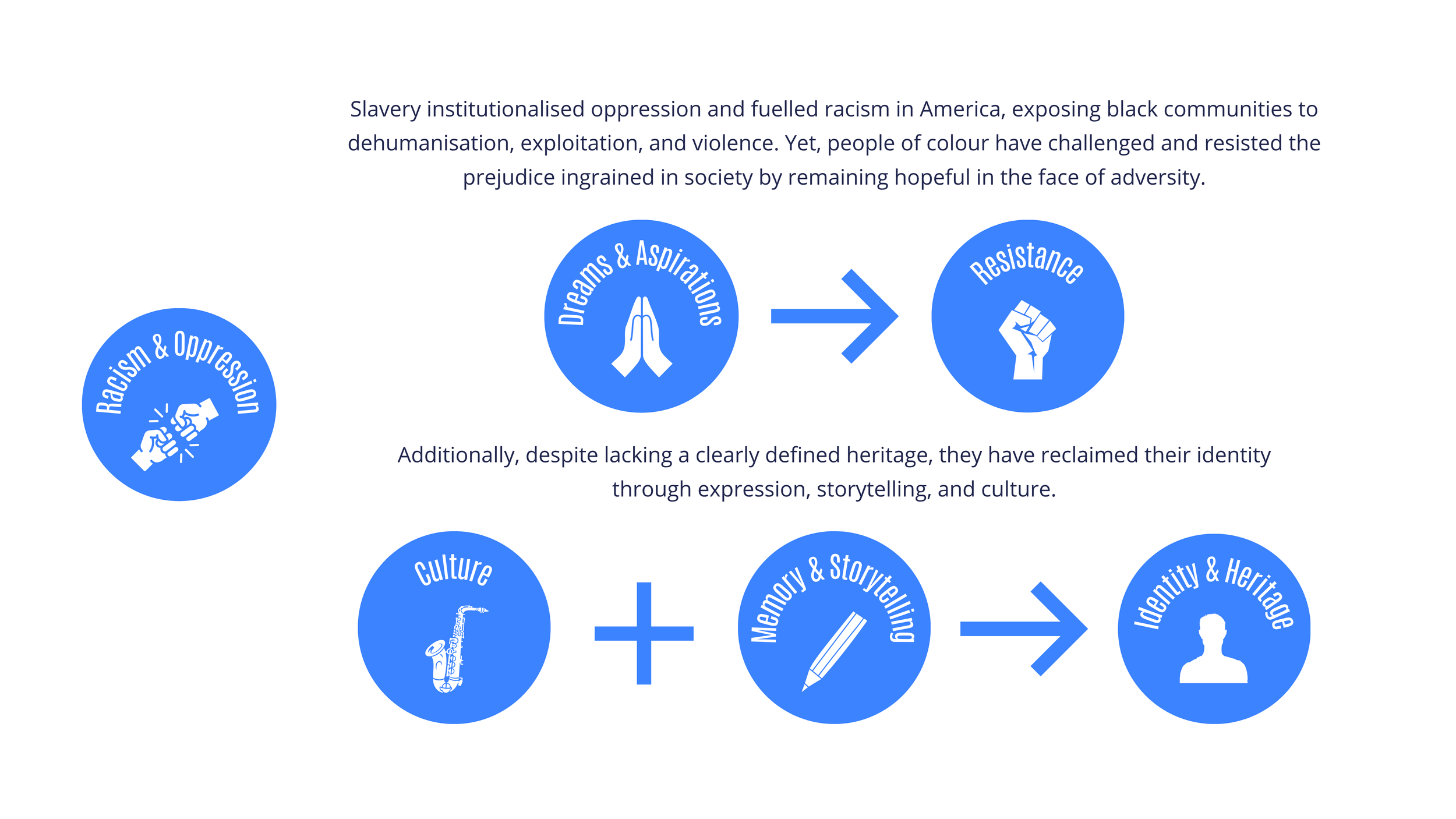
Racism & Oppression:
Hughes exposes that systemic racism, violence, and dehumanisation are embedded in American society and shape Black suffering.
Identity & Heritage:
Hughes explores that Black identity is deeply rooted in ancestral history, culture, and collective memory despite displacement and fragmentation.
Resistance:
Hughes asserts that Black individuals and communities resist oppression and demand dignity, equality, and self-determination.
Dreams & Aspirations:
Hughes suggests that hope, dreams, and collective ambition drive the ongoing struggle for freedom and a more just future.
Culture:
Hughes celebrates that Black cultural expression—through music, dance, and creativity—is a source of pride, resilience, and identity.
Memory & Storytelling:
Hughes emphasises that oral tradition and storytelling preserve Black history, truth, and lived experience beyond written records.
Narrative Elements:
Form — Poetry.
Genre — Jazz Poetry. Conventions and features include: rhythm, rhyme, repetition, improvisational feel, and vernacular language. It is designed to be performed.
Structure — Typically free verse.
Stylistic Features — Repetition, syncopation, punchy lines, colloquial language, and vivid imagery.
Prompt Bank:
“So long, / So far away / Is Africa.” Hughes' poetry suggests that disconnection from heritage creates a fragmented identity. Do you agree?
Hughes critiques the idea that America is built on equality. To what extent do you agree?
“Aunt Sue has a head full of stories.” Hughes' poetry demonstrates that storytelling preserves truth more powerfully than written history. Discuss.
In Hughes' poetry, cultural expression is instinctive and unifying. Do you agree?
How does Hughes' poetry suggest that sacrifice is central to the pursuit of freedom?
“The wall rose… between me and my dream.” Hughes demonstrates that systemic barriers prevent the fulfilment of personal aspirations. Do you agree?
To what extent does Hughes' poetry explore the instability of identity in a racially divided society?
Hughes' poetry imagines a future defined by unity rather than division. Discuss.
“They’ve just hung a black man… for the world to see.” Hughes' poetry exposes the normalisation of racial violence in society. To what extent do you agree?
“The lazy, laughing South / With blood on its mouth.” Hughes' poetry critiques the hypocrisy of a society that is both beautiful and brutal. Discuss.
Exemplary Essay:
Hughes' poetry suggests that disconnection from heritage creates a fragmented identity. Do you agree?
The heritage of a community provides continuity, bridging the gap between each generation; therefore, how can a group of people stay connected when their cultural background has been stripped away? Posing this very question, Langsten Hughes' Selected Poems, first published in 1959, examines the limitations imposed upon Black people following the transatlantic slave trade and during the Jim Crow era in the United States. Empowered by the Harlem Renaissance—a vibrant blossoming of African American culture in the 1920s—Hughes unapologetically exposes the systems that robbed Black people of their heritage, deteriorating their identity and rendering them a target for oppression. Yet refusing to depict African Americans as passive victims, Hughes, drawing from jazz music, celebrates the culture that has flourished within black communities and the rich identity they have cultivated.
Hughes suggests that Black people, with their lack of heritage, have developed a fragmented identity. This is illustrated through Hughes' poem Afro-American Fragment, which features a black person expressing how distant they have grown from their cultural roots. In the refrain, Hughes highlights that the African American community is "so far away" from Africa, not only physically, but psychologically, as white society has "beat" their heritage "out of [their] blood." Here, the repeated use of the letter "b" creates a cacophony of sound, heightening the intensity and brutality inflicted by colonisers seeking to rob African American people of their ancestry. As such, their memories are personified as a living entity struggling to stay "alive," implying that their ability to remember their culture has not only faded, but completely withered away, leaving their identity vulnerable and fragile. Simultaneously, one's memory is widely considered a core component of their selfhood; hence, by depicting its deterioration, Hughes reinforces his belief that African American communities do not develop a unified sense of self — their lack of heritage has shattered and clouded their self-perception, hindering their ability to understand who they are. This is symbolised through Hughes' use of enjambment — just like the mental landscape of black people, each line of Hughes' poem flows and bleeds into the next, accentuating that their memories are not organised into neat categories, but are blurred — further crumbling how they view themselves. This is perfectly encapsulated when Hughes' describes Africa's "face" as "dark," emphasising that the identities of African American individuals are hidden and obstructed as their cultural roots have dwindled.
With a fragile sense of self, Black people have become vulnerable targets for white society to oppress. This is evident in Hughes' poem The South, which personifies the Southern states as a woman who is "beautiful," but "seductive as a dark eyed whore." This creates a sense of irony, highlighting the hypocrisy of the South — while they promised freedom and liberty, they encouraged plantation owners to punish their slaves with violence, abuse, and murder. This is epitomised through Hughes' use of zoomorphism, in which he likens the Southern states to a carnivorous "beast" with "blood on its nose" scratching in the ashes "for a Negro's bones." In drawing this comparison, Hughes highlights how masters viewed their slaves as vulnerable prey, rather than human beings with inherent value, explaining how they were able to rationalise oppressing them. The cruelty of pro-slavery Americans is subtly alluded to when Hughes labels the "South" as "sunny-faced." Here, while this may seem complimentary, his use of sibilance creates a hissing effect, further allowing him to frame plantation owners as sly predators eager to hunt, capture, and exploit members of the African American community. Similarly, Hughes paints a tranquil picture of the South, drawing attention to its "cotton" and "magnolia scent." Yet, this was the environment slaves were exposed to as they performed gruelling manual labour, illustrating how even the seemingly serene aspects of the Southern states were oppressive to black people.
Despite this, Black people have established their own culture in the United States, empowering them to reconstruct their selfhood. In Danse Africaine, Hughes portrays a "night veiled" African American dancer "whirl[ing] softly into a / circle of light." In this passage, the dichotomy between light and darkness amplifies how expressing one's culture enables them to transform the uncertainty about their identity into clarity. This is particularly apparent considering light is often synonymous with knowledge in poetry; thus, by stepping into the light, the dancer is gaining an understanding of who she is as a black woman in the United States. Hughes therefore bolsters the idea that constructing one's own culture results in self-understanding for those with a fractured identity. In a similar fashion, utilising auditory imagery, Hughes paints the picture of "tom-toms" beating "low…[and] slow." Here, his use of rhyme produces a musical rhythm and strategic placement of an ellipsis creates syncopation, mirroring the characteristics of Jazz music, a genre that was developed predominately by black artists as a means of expressing the rich culture they have established in the United States. Even today, jazz music is so deeply interconnected with black culture that the genre itself has become a part of African American identity, further showcasing how re-constructing one's culture shapes their self-image. This is further demonstrated through Hughes' decision to assign his poem a French title. Historically, in the early 20th century, many black artists migrated to Paris to escape systemic racism and segregation, as this cosmopolitan city promoted artistic freedom. Consequently, African American creatives, like Hughes, often pay homage to France in their work, further reinforcing the culture and selfhood fostered by black communities.
Ultimately, Hughes uncovers the forces that have displaced Black heritage, disintegrating the identity of the African American community and leaving them susceptible to subjugation. At the same time, he celebrates the creativity, artistry, and culture of black people, portraying them as strong, resilient, and capable of restoring their collective sense of self. Hence, although individuals without clearly defined cultural roots may struggle understanding who they are, Hughes ultimately invites his audience to recognise that identity is not fleeting; it can be reshaped and reclaimed through the creation and celebration of new cultural expressions.